The 15th of Sha’ban draws hundreds of thousands of pilgrims to Karbala every year. It is a quieter gathering than Arbaeen in raw numbers, but it is still one of the most significant religious occasions on the Shia Islamic calendar, and it presents its own specific logistics challenges for groups traveling together.
If you are leading a family group, a community delegation, or a small caravan of friends from the UK, Pakistan, or anywhere else in the world, the days around 15 Sha’ban in Karbala require the same kind of connectivity preparation you would give a much larger event. The difference is that with the right setup, the experience can be significantly more manageable than Arbaeen.
This guide covers the religious context, the crowd reality, the connectivity experience, and the practical tools your group needs to stay coordinated from the moment you arrive until you leave.
The 15th of Sha’ban holds profound spiritual significance in Shia Islamic tradition as the birthday of Imam Muhammad al-Mahdi (AS), the twelfth Imam and awaited reformer. The night before the 15th, known as Laylat al-Nisf min Sha’ban (the middle night of Sha’ban), is observed across the Muslim world as a night of prayer, supplication, and remembrance.
In Karbala specifically, the occasion draws pilgrims to the shrine of Imam Hussein (AS) and the shrine of Hazrat Abbas (AS) for extended night prayers, Ziyarah, and communal gatherings. The atmosphere is celebratory rather than mournful, marked by lights, recitations, and large communal supplications in the shrine courtyards and surrounding streets.
For first-time 15 Sha’ban visitors: The central ritual for most pilgrims is the night vigil from the eve of the 15th through to Fajr. Many pilgrims arrive the day before, perform evening prayers at the shrine, and remain through the night. The days immediately surrounding the 15th see a steady flow of pilgrims in and out of Karbala, with the night itself being the peak of both spiritual activity and crowd density.
Understanding when the crowd peaks shapes every practical decision you make about accommodation, connectivity, transport, and group coordination.
15 Sha’ban is a significant occasion, but it is a different order of scale from Arbaeen. Understanding this distinction helps you calibrate your preparation correctly.
| Factor | 15 Sha’ban in Karbala | Arbaeen in Karbala |
| Approximate visitors | Several hundred thousand | 15 to 20 million |
| Duration of peak crowd | 24 to 48 hours (night-centred) | 72 hours (procession and shrine) |
| Geographic spread | Concentrated at shrine area | Shrine + 80 km procession route |
| Network congestion level | Moderate to high near shrine | Severe during peak hours |
| Accommodation pressure | High but manageable | Extreme |
| Transport disruption | Partial road restrictions | Extensive route closures |
The practical implication: 15 Sha’ban is absolutely an occasion that requires preparation, but it does not require the same extreme contingency planning that Arbaeen demands. WhatsApp calling generally works, albeit slowly, during 15 Sha’ban night. Navigation apps function with noticeable lag. Group coordination via WhatsApp is stressed but functional for most of the occasion.
Plan for a moderately congested experience rather than the near-total data saturation of Arbaeen peak hours.
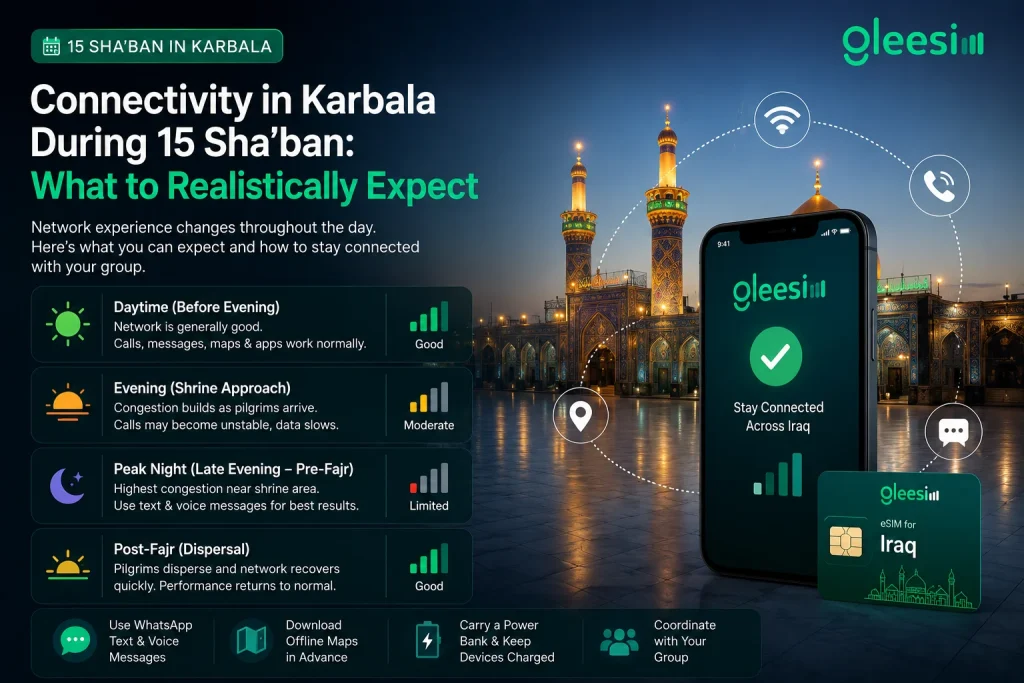
The night of 15 Sha’ban creates a localised surge in mobile network demand within a few kilometres of the shrine complexes. This is predictable, manageable, and significantly less severe than Arbaeen.
During the day (before the main evening): Network performance in Karbala is broadly normal. WhatsApp calls, group messages, photo sharing, and navigation all work at standard speeds on both Asiacell and Zain Iraq networks. This is your window to confirm group meeting points, share offline maps with everyone, and make any calls that require clear audio.
Evening and early night (shrine approach): As pilgrims converge on the shrine area from around Maghrib prayers onwards, network congestion builds steadily. WhatsApp voice calls become less stable. Text messages and audio notes continue to push through, with some delay. Media sharing (photos and videos) slows noticeably.
Peak night (late evening through to pre-Fajr): The deepest congestion occurs in the immediate shrine courtyards and surrounding streets during the late-night supplication period. This is where your group is most likely to need connectivity and where it is most challenged. Text WhatsApp messages remain your most reliable communication channel during this window.
Post-Fajr and dispersal: Connectivity recovers relatively quickly as pilgrims disperse from the shrine after Fajr prayers. Within an hour or two of the dispersal beginning, network performance in most parts of Karbala returns to normal.
For visitors to Karbala on 15 Sha’ban, the SIM card decision follows the same logic as any Ziyarah trip, with one additional factor: if you are leading a group, your connectivity matters more than an individual traveller’s because your phone is the coordination hub.
Local Iraqi SIM (Asiacell recommended): Asiacell provides the strongest direct coverage in the Karbala shrine area. For group leaders specifically, having a local Asiacell SIM gives you the most robust connection to local network infrastructure during the 15 Sha’ban night peak. Purchase at Najaf International Airport on arrival or at a licensed dealer in Karbala city centre. Passport registration is mandatory.
International travel eSIM (GleeSim): GleeSim offers Iraq eSIM plans activated entirely through WhatsApp before your flight, with no app download and no airport registration required. For group leaders and tour coordinators arriving with a delegation, having your data connection live from the moment you land means you can manage pre-arrival logistics (accommodation check-in, airport pickup coordination, arrival messages to group members) without queuing at a SIM desk on arrival.
Browse current Iraq plans at gleesim.com/esim-iraq and activate over WhatsApp at least forty-eight hours before departure.
The dual approach for group leaders: If your phone supports eSIM alongside a physical SIM slot, carrying both a GleeSim eSIM and a local Asiacell SIM is the optimal setup for a 15 Sha’ban group coordination role. Your GleeSim line handles pre-arrival and early-trip logistics. Your Asiacell SIM provides the strongest local coverage during the shrine night itself.
| Factor | Local Asiacell SIM | International eSIM (GleeSim) | Home Carrier Roaming |
| Active before landing | No | Yes, via WhatsApp | Yes |
| Coverage at shrine (15 Sha’ban night) | Strongest | Good | Variable |
| Congestion resilience | Good (primary network) | Good (roaming path) | Depends on roaming partner |
| Cost (7-10 day trip) | Lowest | Competitive | Potentially high |
| Group leader suitability | Strong once registered | Strong from arrival | Risky if expensive |
| Plan management | USSD codes | WhatsApp conversation | Home carrier app |
For a short 15 Sha’ban trip of three to seven days, the cost difference between a local Iraqi SIM and a GleeSim eSIM is small. The meaningful difference is convenience: a local SIM requires airport registration and a GleeSim eSIM does not. For solo pilgrims, this convenience gap is a personal choice. For group leaders arriving with a delegation to coordinate, being connected from the moment you clear customs is worth the marginal cost difference.
This is a question specific to groups and it deserves a direct answer rather than a vague “all three work.”
WhatsApp for 15 Sha’ban group coordination: WhatsApp is the practical choice for virtually every pilgrimage group traveling to Karbala because every member already has it, families back home already have it, and it handles voice notes, live location, and group messaging in a single familiar interface. WhatsApp Live Location sharing within the group is the single most useful safety feature available for keeping tabs on where different group members are during the shrine night.
Telegram as a supplement: Telegram handles larger groups (up to 200,000 members) and offers better file sharing for large documents, itineraries, and pre-trip logistics. Some pilgrimage tour operators use Telegram for group-wide announcements and WhatsApp for personal and small-group communication. If your group exceeds WhatsApp’s 1,024 member limit (relevant for large community delegations), Telegram handles the scale without limitation.
SMS as a fallback: Plain text SMS routes through the 2G voice channel rather than the data network. During the deepest network congestion near the shrine on the night of 15 Sha’ban, SMS often delivers when WhatsApp messages queue for extended periods. Agree on a group SMS broadcast number or a specific emergency SMS contact before the trip, so everyone knows where to send a plain text message if WhatsApp stops working.
| Method | Data Required | Group Size Limit | Works Under Congestion | Recommended Use |
| WhatsApp group | Yes (data) | 1,024 members | Partially (text better than media) | Primary coordination |
| WhatsApp Live Location | Yes (data) | Per share | When data is available | Real-time position sharing |
| Telegram group | Yes (data) | 200,000 members | Partially | Large delegations |
| Plain text SMS | No (voice channel) | No group limit | Best of all options | Emergency fallback |
The shrine area on the night of 15 Sha’ban is densely crowded, particularly in the hours before and after midnight. Group separation is a real risk, especially for larger family groups traveling with children or elderly members.
Designate meeting points before you enter the shrine area: Identify two or three fixed physical landmarks your entire group knows, independent of any app or connectivity. The main gate of the Imam Hussein (AS) shrine, a specific tea stall your group identifies in the afternoon, or a Mawkib tent at a confirmed address. If your group separates and data fails, everyone knows where to walk to.
Assign a group coordinator who stays outside the inner courtyard: For groups of eight or more, having one person positioned just outside the main crowd with line-of-sight to an open area often means they maintain better connectivity than those inside the densest shrine sections. This person becomes the communication hub for the group.
Pre-agreed check-in schedule: Agree on specific check-in times over WhatsApp before entering the shrine area: one message at 11pm, one at 2am, one at Fajr. Group members who are separated know these are the windows to send location or status updates. This removes the anxiety of radio silence between check-ins.
WhatsApp Live Location for the whole group: Before entering the shrine area, ask every group member to share their Live Location in the group chat for a duration that covers the night (eight hours is sufficient). This way, even when voice calls fail, anyone with intermittent data can see the approximate position of every other group member on the map.
Save these before you leave, and share the list with every group member in both digital and printed form.
| Service | Contact |
| Iraqi Police | 104 |
| Ambulance | 122 |
| Civil Defence | 115 |
| Karbala Health Directorate | +964 32 3331111 |
| Karbala Pilgrimage Operations | Contact your tour operator |
| Pakistani Embassy Baghdad | +964 7901 289 001 |
| UK Embassy Baghdad | +964 7901 926 280 |
| FCDO 24-hour helpline (UK nationals) | +44 1908 516 666 |
| Overseas Pakistanis helpline (from abroad) | +92 51 9204 979 |
Every group member should have these saved as named contacts on their phone, not only as a shared document or WhatsApp message. When your data connection is down and you need to make an emergency call, the number must be accessible without internet.
The preparation window is before you enter the shrine district, ideally at your accommodation in the hours before the evening begins.
Navigation: Download Google Maps offline for Karbala city before the evening. Star your accommodation address, the main shrine entrance, and your designated group meeting points. Maps.me with Iraq downloaded adds more detailed coverage of the shrine alleyways. Both apps use GPS without any data connection, so your position shows on the map even when the network is fully congested.
Ziyarah and religious content: Mafatih app with 15 Sha’ban duas and supplications downloaded for offline access. Quran app with relevant surahs and Dua Kumayl downloaded. Al-Hussain app if your group follows its content calendar. Download all of this on accommodation Wi-Fi before the evening begins.
Group coordination preparation: Share your accommodation address and entrance pin in the group chat while everyone is on Wi-Fi. Share the designated meeting point locations as dropped pins rather than typed addresses. Confirm that every group member has the emergency contact list saved locally on their phone.
What are the best mobile operators and SIM card options for visitors in Karbala?
Asiacell provides the strongest direct coverage in the Karbala shrine area and is the recommended local SIM for pilgrims visiting on any occasion including 15 Sha’ban. Zain Iraq is a solid alternative. For visitors who want a data connection active before landing, GleeSim offers Iraq eSIM plans activated over WhatsApp with no airport registration required.
How crowded does Karbala get on 15 Sha’ban and how does that affect group movement?
Karbala on 15 Sha’ban receives several hundred thousand visitors, concentrated over a 24 to 48-hour window centred on the night. This is significantly less congested than Arbaeen but still dense enough to cause group separation in the shrine courtyards. Network congestion during peak shrine hours is moderate to high, meaning WhatsApp text messages push through with delay while voice calls and media sharing become unreliable.
Are there recommended apps or offline maps for navigating Karbala during religious events?
Google Maps offline for Karbala and Maps.me with Iraq downloaded both work without any internet using your phone’s GPS. Download both before entering the shrine area. For Ziyarah content, Mafatih with offline supplications and Quran apps with downloaded audio cover the religious content needs without requiring data during the night.
What safety and emergency contacts should my group have while in Karbala on 15 Sha’ban?
Iraqi Police (104), Ambulance (122), Karbala Health Directorate (+964 32 3331111), and your country’s embassy in Baghdad are the minimum. Every group member should have these saved as named phone contacts, not only in a WhatsApp message that requires data to retrieve.
How can I rent a portable Wi-Fi hotspot or get reliable internet access in Karbala?
Portable Wi-Fi rental in Karbala for pilgrimage visitors is not as established as in some tourist destinations. Your hotel Wi-Fi is the most reliable internet source during your stay and should be used for all heavy data tasks in the evenings. For mobile data throughout the day, a local Asiacell SIM or a GleeSim Iraq eSIM is more dependable than trying to locate and rely on a rental Wi-Fi device.
For pilgrims who have attended Arbaeen and are now planning their first 15 Sha’ban trip, or vice versa, this comparison helps calibrate expectations correctly.
| Factor | 15 Sha’ban | Arbaeen |
| Crowd scale | Hundreds of thousands | 15 to 20 million |
| Primary activity | Night vigil at shrine | 80 km procession walk + shrine |
| Duration of peak | One night | Three days |
| Accommodation availability | Tight but bookable | Extremely limited |
| Network congestion | Moderate to high | Severe during peak |
| WhatsApp voice calls | Unstable near shrine at night | Largely unusable at peak |
| WhatsApp text messages | Delayed but functional | Slow but eventually deliver |
| Group coordination difficulty | Manageable with preparation | Requires extensive pre-planning |
| Transport access | Partial restrictions | Extensive route closures |
If Arbaeen is the most logistically demanding pilgrimage experience a Shia Muslim traveller will face, 15 Sha’ban sits at a level that is genuinely manageable with one to two days of preparation. The connectivity challenges are real but not overwhelming. The crowd density is significant but not so extreme that group coordination becomes impossible.
Accommodation in Karbala around 15 Sha’ban fills up well in advance of the date, particularly rooms within walking distance of the shrine complex.
Hotels near the shrine: The immediate shrine district has a range of hotels serving pilgrims at various price points. Rooms within five minutes of the main shrine gate are the most sought after and book out earliest. For groups, booking a block of adjacent rooms in the same property simplifies morning logistics and provides a clear base for the group to return to.
Husayniyyas and community lodging: Many national and community husayniyyas operate in Karbala and offer accommodation to visiting delegations, particularly around major dates. These are typically free or low-cost but require advance contact and coordination through community networks rather than online booking platforms. If your group has a community sponsor or tour operator, ask specifically about husayniyya accommodation for 15 Sha’ban.
Nearby towns: Some groups, particularly larger delegations that cannot secure enough rooms in central Karbala, stay in Hillah or other nearby towns and travel to Karbala for the shrine night. This reduces accommodation pressure but adds transport logistics on the night when road restrictions are in place. Weigh this trade-off carefully for your group’s specific needs.
Staying central vs staying nearby:
| Factor | Central Karbala Hotel | Nearby Town Accommodation |
| Walking distance to shrine | Yes | No, requires transport |
| Transport on 15 Sha’ban night | Walk or short taxi | Restricted, plan carefully |
| Cost | Higher | Lower |
| Group coordination simplicity | High | Lower |
| Booking availability | Tight, book early | More available |
For groups with elderly members or children, staying within walking distance of the shrine and eliminating transport dependency on the night itself is strongly recommended.
Moving a group around Karbala during 15 Sha’ban requires advance planning because road restrictions affect the shrine district during peak hours.
Public shared taxis (Service): Shared taxis operate between Karbala districts and between Karbala and Najaf throughout the day. During the evening and night of 15 Sha’ban, availability near the shrine reduces as roads fill. For groups, public taxis require splitting across multiple vehicles, which creates separation risk if your WhatsApp coordination fails.
Private minibus hire: For groups of eight or more, hiring a private minibus with a driver for the duration of your stay is the most practical option. Your driver becomes a fixed point of contact, can wait at a designated pick-up point outside restricted zones, and eliminates the need to coordinate multiple taxi pickups. Rates are negotiable in Karbala and many tour operators include transport in their package.
Walking from accommodation: For groups staying within the shrine district, the simplest and most reliable transport option is walking. Karbala’s shrine area is compact enough that most pilgrimage accommodation is within fifteen to thirty minutes of both the Imam Hussein (AS) and Abbas (AS) shrines on foot. Walking also eliminates dependency on road availability during restrictions.
Karbala during major pilgrimage occasions has extensive Mawkib food and water provision. Free meals, tea, and water are distributed throughout the shrine district and surrounding streets by community volunteers. For a night vigil occasion like 15 Sha’ban, this provision is genuinely substantial.
Practical health precautions for groups: Carry personal water bottles regardless of free water availability. The shrine area can be physically demanding during warm months and dehydration is a risk during extended night vigils. For groups traveling between April and October, the heat at night in Iraq remains significant and group members should be reminded to drink water regularly.
Foot care is more relevant for pilgrims walking long distances. For a 15 Sha’ban trip centred on the shrine rather than a procession route, comfortable walking shoes are sufficient.
Food safety: Volunteer-prepared food distributed at shrines and Mawkibs is generally prepared to reasonable standards and is consumed by millions of pilgrims without incident. Pilgrims with specific dietary requirements or health conditions should carry supplementary provisions from their accommodation.
Visa requirements for entering Iraq vary by nationality. Most visitors need an Iraqi visa in advance, though the Iraqi government periodically offers visa-on-arrival facilities at Najaf International Airport for pilgrimage visitors around major Islamic dates.
For Pakistani pilgrims: Pakistani nationals require a visa for Iraq. Special pilgrimage visa arrangements are sometimes available for Pakistani groups around 15 Sha’ban. Confirm current requirements with the Iraqi Embassy in Islamabad or through your tour operator at least four weeks before departure.
For UK nationals: UK passport holders require a visa for Iraq. Applications are made through the Iraqi Embassy in London. Pilgrimage tour operators with established Iraq relationships often assist with visa processing for group delegations.
General guidance: Verify visa requirements specific to your nationality at least four to six weeks before travel. Requirements change seasonally and the Iraqi government’s treatment of pilgrimage visitors varies around different occasions. Your tour operator or the Iraqi Embassy in your country is the authoritative source.
The 15 Sha’ban occasion is frequently managed by community leaders, mosque committees, and informal caravan coordinators rather than commercial tour operators. If you are organising a group for the first time, these practical tips reflect lessons from experienced pilgrimage coordinators.
Connectivity setup for the group leader specifically: Activate your GleeSim Iraq eSIM before departure so you are connected from the moment you land. As group leader, you will be coordinating airport pickups, accommodation check-ins, and early logistics before the rest of the group has sorted their SIMs. Being connected before you clear baggage claim is not a luxury for a group leader, it is a basic operational requirement.
Role assignment before departure: Assign a deputy coordinator who holds a separate copy of all group contacts, emergency numbers, and accommodation details. If your phone is lost or runs out of battery at a critical moment, the deputy steps in. This single redundancy step has resolved more pilgrimage crises than any app or connectivity solution.
Itinerary document shared offline: Prepare a one-page itinerary with accommodation address, airport meeting point, shrine visit timings, and emergency contacts. Share it in the WhatsApp group before departure and ask every member to screenshot it to their camera roll. A screenshot is accessible without data; a WhatsApp message is not.
Pre-departure group call: Run a five-minute voice or video call with the full group at least forty-eight hours before departure. Confirm that every member has the emergency contacts saved, knows the accommodation address, understands the meeting point plan for the shrine night, and has working data coverage on their phone. Issues discovered here are easy to solve. Issues discovered at 1am in the Karbala shrine courtyard are not.
Here is the practical connectivity recommendation based on everything in this guide.
For group leaders and caravan coordinators, activate a GleeSim Iraq eSIM before your flight. If your phone has a second SIM slot, add a local Asiacell SIM on arrival for maximum coverage at the shrine during the night. Use WhatsApp Live Location sharing within your group from the start of the shrine evening. Agree on plain text SMS as your fallback when WhatsApp data stalls.
For individual group members, a local Asiacell SIM from the airport is sufficient for the trip if your phone does not support eSIM. If it does, a GleeSim eSIM activated before departure removes the airport queue entirely and gives you data for the full trip including pre-arrival coordination.
Either way, download your offline maps, your Ziyarah duas, and your group itinerary screenshot before you leave your accommodation for the shrine. Everything critical should be accessible without any network connection by the time you enter the crowd.
Browse Iraq eSIM data plans and activate yours over WhatsApp before your 15 Sha’ban trip at offers.gleesim.com/iraq.
This guide reflects general conditions and practical guidance based on publicly available information. Crowd conditions, visa requirements, and network performance for 15 Sha’ban in Karbala vary year to year. Emergency contact numbers should be verified before travel. Consult your tour operator or relevant embassy for current visa and entry requirements specific to your nationality.