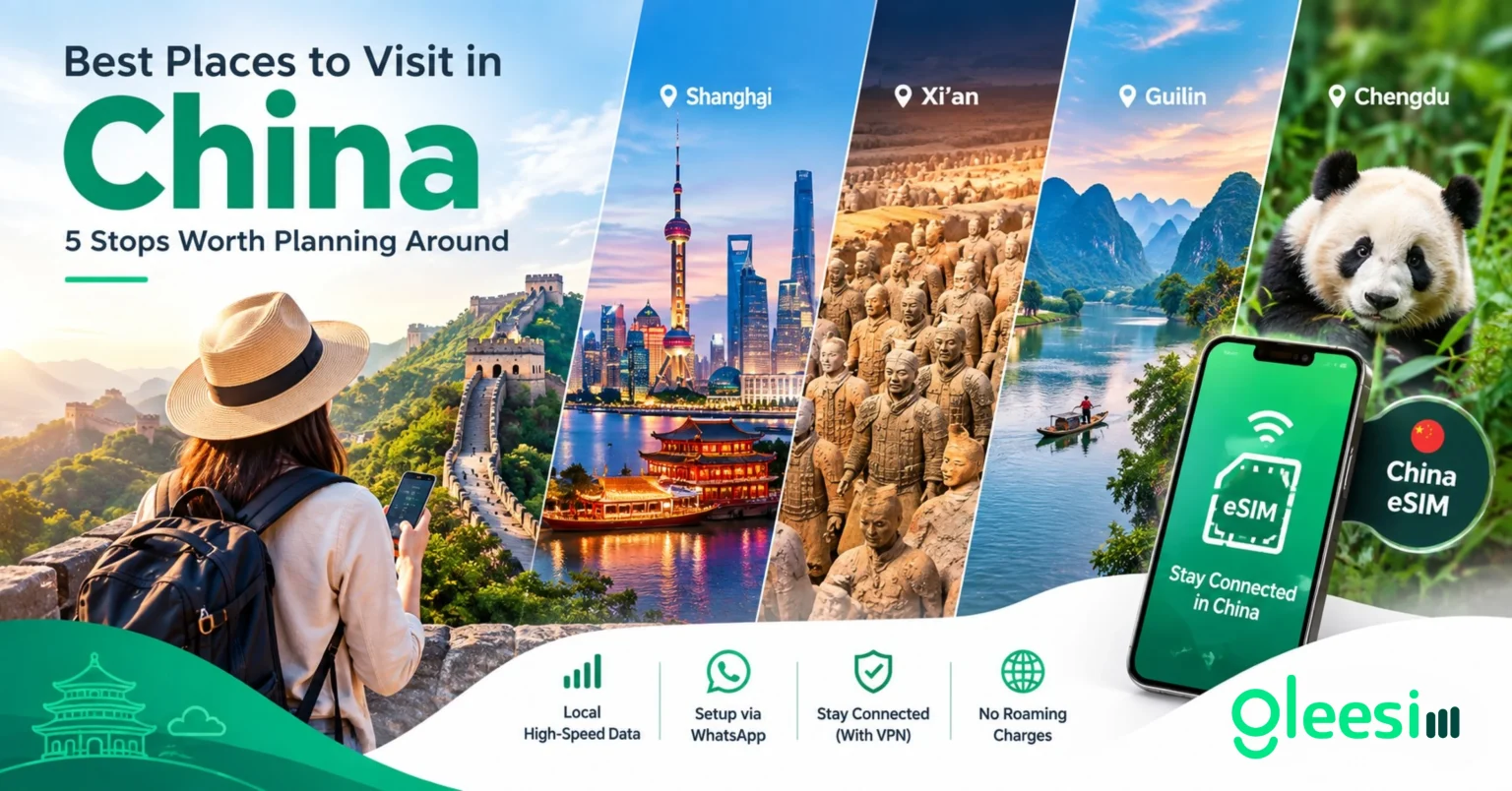
China covers such a wide range of landscape and history that most first-time visitors end up picking a handful of cities rather than trying to cover the whole country. The best places to visit in China mix imperial history, modern skylines, and landscapes that look almost painted, and getting between them is usually a high-speed train ride rather than a flight, since the rail network connects most major cities in a few hours. This guide covers five stops worth building an itinerary around, plus something that catches a lot of travelers off guard: what happens to apps like WhatsApp and Google Maps once you actually land.
Beijing is where most China trips start, and for good reason. The Forbidden City alone needs the better part of a day to see properly, and it sits right next to Tiananmen Square if you want to cover both in one stretch. The Great Wall is the other must-see, and the Mutianyu section is a better choice than the closer, more crowded Badaling section for anyone who wants fewer tour groups in every photo. Two or three full days covers the main sites without rushing through them.
Shanghai is the counterpoint to Beijing’s history, a city built around a skyline that barely existed thirty years ago. The Bund, a riverside promenade lined with colonial-era buildings, faces directly across the water at the futuristic towers of Pudong, and walking it at night when everything is lit up is worth doing even if you skip it during the day. Yu Garden and the surrounding old town give a slower, older side of the city if the skyscrapers start to feel like a theme park.
Xi’an is the stop most people build their whole trip around once they see photos of the Terracotta Army, thousands of individually sculpted clay soldiers buried to guard the tomb of China’s first emperor. The scale of the excavation pits is hard to picture until you are standing in front of one. Xi’an’s old city walls, some of the best preserved in the country, are also worth an hour on a rented bike, and the Muslim Quarter nearby has some of the best street food of the whole trip.

Guilin and the nearby town of Yangshuo are where the limestone karst mountains that show up on Chinese landscape paintings actually exist. A boat cruise down the Li River between the two towns is the classic way to see them, though renting a bike in Yangshuo and riding through the rice paddies and smaller peaks gives a slower, cheaper version of the same scenery. This region is a different pace entirely from Beijing or Shanghai, and most visitors find it a good place to slow down mid-trip.
Chengdu is the base for visiting giant pandas, and the research base just outside the city is set up to let visitors see them without the stress of a traditional zoo enclosure. Go early morning if possible, since pandas are more active before the heat of the day sets in. Chengdu is also the home of Sichuan cuisine, and the food here runs genuinely spicy rather than the milder version served outside the region, so pace yourself on the first night.
This is the part a lot of travel guides skip. China blocks access to WhatsApp, Google (including Maps and Gmail), Instagram, and Facebook on local networks, a system usually called the Great Firewall. This applies regardless of which SIM or eSIM you are using, since it is a network-level restriction, not something tied to a specific carrier. Most travelers handle this with a VPN app downloaded and set up before arriving in China, since VPN apps themselves are harder to install once you are already on a restricted network.
A China eSIM still solves the core connectivity problem, giving you local data speeds without roaming charges or hunting for a SIM shop after a long flight. GleeSim sets this up over WhatsApp before you fly, and the setup process itself works fine since you are not in China yet when you message. Once you land, a VPN app installed in advance restores access to the apps you are used to using, including WhatsApp itself for messaging home.
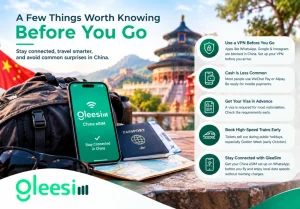
Download and test your VPN app before you leave home, not after you land, since app stores and VPN provider websites are also blocked once you are on a Chinese network. Cash is used far less than you might expect, and most local payment happens through WeChat Pay or Alipay, both of which are harder for short-term visitors to set up than a Western tourist might assume. A visa is required for most nationalities and needs to be arranged before travel, so check requirements well ahead of booking flights. High-speed trains sell out during Chinese public holidays, particularly Golden Week in early October, so book those tickets early if travel dates overlap.
Will a China eSIM let me use WhatsApp and Google Maps without a VPN? No. Apps like WhatsApp, Google, Instagram, and Facebook are blocked on all networks inside China, eSIM or otherwise. A VPN installed before you arrive is what restores access to those apps.
Do I need a different eSIM for Beijing versus Xi’an or Chengdu? No, a single China eSIM plan covers the whole country, so switching cities by train or flight does not require a new setup at each stop.
How much data is enough for a two-week China trip? Ten to fifteen gigabytes covers most travelers using maps and messaging through a VPN, uploading photos, and occasional video calls. Heavier streaming use pushes that higher.
Can I top up my China eSIM if I run low partway through the trip? Yes, a WhatsApp message before you leave home sets this up so a top-up can be added the same way, though remember that once you are in China you will need your VPN active to reach WhatsApp itself.
Beijing, Shanghai, Xi’an, Guilin, and Chengdu make a strong first trip through China, and getting the connectivity and VPN setup sorted before departure means less troubleshooting once you land. Message GLEE10 on WhatsApp before you fly for 10% off a China eSIM plan, check live pricing on the Gleesim offers page, or see full plan details on the Gleesim China eSIM page. Traveling for work instead of sightseeing? The Gleesim guide for China business travelers covers the setup from a slightly different angle.