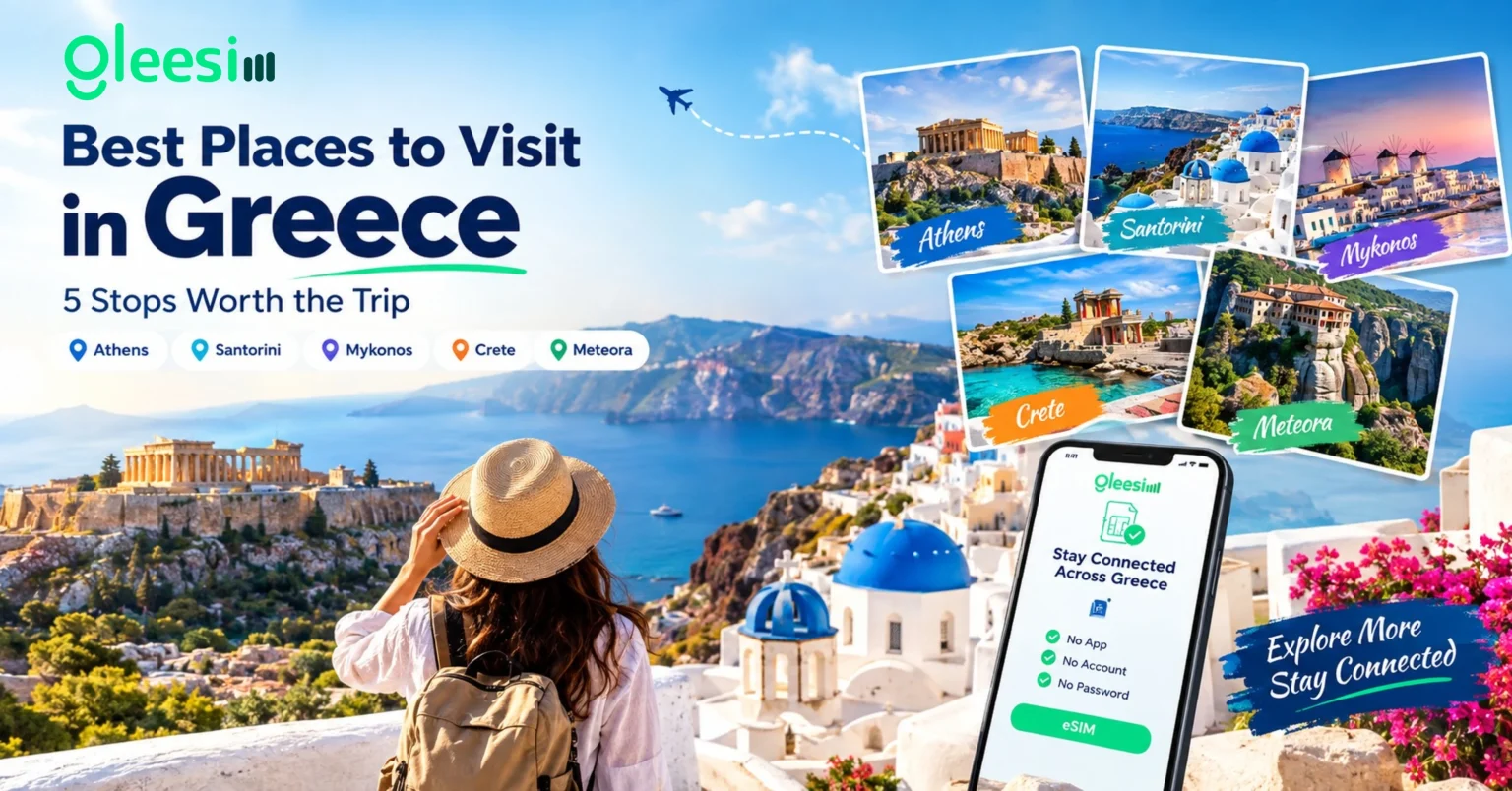
Greece rewards travelers who plan a proper route instead of parking themselves on one island for a week. The best places to visit in Greece span ancient ruins, whitewashed clifftop towns, and monasteries built on top of rock towers, and getting between them usually means a ferry, a short flight, or a rental car. That is also where a lot of travelers run into trouble with their phone plan, since a home SIM built for one country does not always keep up with island hopping. This guide covers five stops worth building a trip around, plus what to set up before you land so maps and messages keep working the whole way.
Athens is the obvious first stop, and the Acropolis is worth the early morning queue. Get there for opening time if you can, since the marble gets hot and crowded fast once the tour buses arrive. Below the hill, the Plaka neighborhood is where most first-time visitors end up wandering for a few hours, and it connects easily on foot to the Ancient Agora and the newer Acropolis Museum. Two full days in Athens is enough to see the main sites without rushing, which leaves more time for the islands.
Santorini is the one photo everyone has already seen before they land, blue domes over a caldera that used to be a volcano. Oia at sunset is genuinely busy, so if crowds bother you, Imerovigli offers a similar view with far fewer people. Fira is the practical base for buses and day trips. The caldera-facing hotels are expensive for a reason, but even a cheaper room a short walk inland still puts you close to the same views and the wineries scattered across the island.
Mykonos gets grouped with Santorini on a lot of itineraries, but the two islands are different trips. Mykonos Town, with its narrow white streets and Little Venice waterfront, is worth a slow afternoon on its own. The beach scene here leans loud, with beach clubs at Paradise and Super Paradise, so it suits travelers looking for that specifically. Quieter coves like Agios Sostis exist if the party beaches are not the point of the visit.

Crete is large enough that it does not feel like an island at all once you are driving through it. Knossos, just outside Heraklion, is where the Minoan palace ruins sit, and it is a different kind of ancient history than Athens. Chania’s old harbor, with its Venetian lighthouse and narrow lanes, is one of the more relaxed bases in the country for a few nights. Crete also has beaches that rival the Cyclades without the same crowds, particularly around Elafonissi in the southwest.
Meteora sits inland, a few hours from Athens by train or car, and it looks nothing like the rest of the country. Six working monasteries sit on top of tall sandstone pillars, built centuries ago partly for defense and partly for isolation. Most visitors base themselves in the nearby town of Kalambaka and spend a full day driving or walking between the monasteries that are open to visitors. It pairs well with a stop in Delphi if the route allows for it, since both sites reward slowing down rather than rushing through.
Greece sits inside the EU, which confuses some travelers into assuming their home SIM will just work the way it does back home. That depends entirely on where home is. Visitors from outside the EU still pay standard international roaming rates, and even EU-based plans sometimes throttle data heavily after a set limit once you are abroad. An eSIM built specifically for Greece sidesteps both problems, since it is a local data connection from the start rather than a roaming add-on.
GleeSim sets this up entirely over WhatsApp, without an app to download or a dashboard to manage. Message the number, say roughly where you are headed and for how long, and a QR code comes back in the chat. Install it on WiFi before you fly, and it switches on as soon as your phone finds a signal in Greece. Ferries between islands sometimes lose signal mid-crossing, which is normal and not a sign anything is wrong with the eSIM itself.

Booking ferries at the last minute in July and August often means sold-out routes, so buy tickets a few weeks ahead in peak season. Santorini and Mykonos hotel prices roughly double between June and September, so shoulder season, May or late September, gets a similar experience for less. Renting a car on Crete is worth it, since public transport does not cover the island well, but an international driving permit is required alongside a home license. Finally, do not plan a ferry connection with less than a few hours of buffer, since island ferries run late more often than they run on time.
Do I need a different eSIM for each Greek island? No. One Greece eSIM plan covers the whole country, islands included, as long as there is mobile signal on that island. You do not need to switch plans when you take a ferry from Santorini to Mykonos.
How much data do I actually need for two weeks in Greece? Most travelers using maps, messaging, and some photo uploads are comfortable on 10 to 15GB for a two-week trip covering Athens and two or three islands. Heavier use, like video calls home or streaming, pushes that higher.
Will my eSIM work on the ferry between islands? Coverage follows land-based networks, so signal can drop mid-crossing on longer ferry routes and comes back once you are close to the next island. This is standard for any SIM, not specific to eSIMs.
Can I top up my data if I run low partway through the trip? Yes. A quick WhatsApp message adds more data to the same active plan, so a longer stay in Crete than originally planned does not mean starting the setup over.
Building a Greece trip around Athens, Santorini, Mykonos, Crete, and Meteora means covering a lot of ground by ferry, plane, and car, and the connection should be the one thing you do not have to think about along the way. Message GLEE10 on WhatsApp for 10% off a Greece eSIM plan, check current pricing on the Gleesim offers page, or see full coverage and plan tiers on the Gleesim Greece eSIM page before you go. For general setup questions that apply anywhere you travel, the Gleesim travel eSIM guides hub covers the basics in more detail.