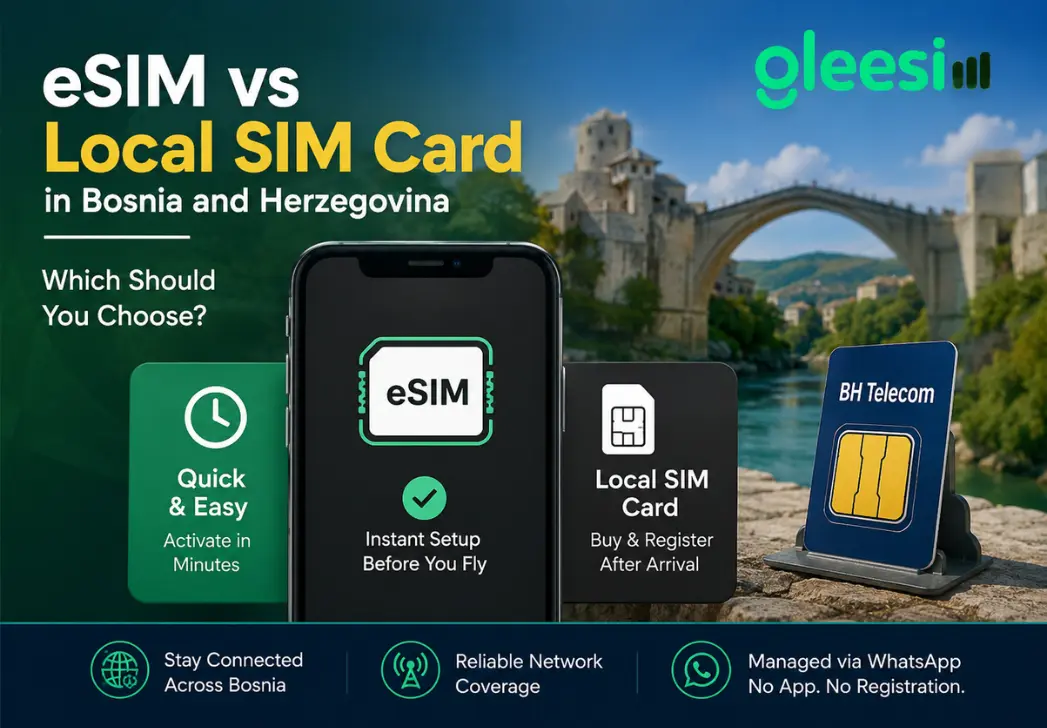
Are you trying to decide between grabbing a SIM card at a kiosk in Sarajevo or sorting your data out before you leave home? Both routes get you connected, but they lead to very different first few hours in the country.
This article will help you understand exactly how these two options compare. After developing a complete understanding, you can make a better decision that fits how you actually like to travel.
Bosnia’s local operators sell prepaid SIM cards through kiosks, phone shops and some airport counters. Buying one usually means presenting ID, waiting for the vendor to register it, and physically swapping it into your phone. For most tourists this takes somewhere between ten minutes and half an hour, depending on the queue and how busy the shop is.
Prepaid SIM, in simple terms, is a physical card tied to a local number that you top up with credit as you go. It requires a compatible, unlocked phone and a slot to insert the card, which some newer phones no longer have.
An eSIM skips the physical card entirely. You buy it online, receive a QR code, and install it directly through your phone’s settings. Because it installs digitally, you can do this before you even leave home, and your connection is already live the moment you land.
| eSIM | Local SIM Card | |
| Purchase | Online, before you travel | In person, after arrival |
| Setup time | A few minutes, done in advance | Ten to thirty minutes on arrival |
| ID required at purchase | No | Usually yes |
| Works on newer phones without a SIM slot | Yes | No |
| Keeps your home number active | Yes, alongside the eSIM | Only with a second physical slot |
If you’re staying in Bosnia for an extended period, months rather than weeks, a local SIM tied to a Bosnian number can work out cheaper for heavy, ongoing use. It also gives you an actual local phone number, which matters if you need one for a local bank account, a rental agreement, or similar paperwork.
For a standard holiday or business trip, the time saved on arrival is the real advantage. No queue, no ID check, no risk of a shop being closed when your flight lands late. You also avoid the small but real risk of losing a physical card or damaging the slot when swapping it in and out.
Do I need to unlock my phone to use a Bosnia eSIM? Your phone needs to support eSIM technology and not be locked to a single carrier. Most phones bought outright already meet this.
Is a local SIM cheaper than an eSIM for a short trip? Not usually once you account for the time spent buying and registering it. For trips under a couple of weeks, the price difference is often small enough that the convenience of an eSIM wins out.
Can I keep my home number active with either option? Yes with an eSIM, since it runs as a second profile alongside your existing SIM. With a physical local SIM, you’d need a dual SIM phone to do the same.
Which Bosnian networks does an eSIM connect to? Coverage runs across Bosnia’s major networks, giving you the same reach as a local SIM without the setup at the airport.
See GleeSim’s Bosnia and Herzegovina eSIM page for current bundle pricing. When you are ready, get your bundle on offers.gleesim.com and skip the queue entirely.