Walking the Camino Frances or Camino del Norte and wondering where you will actually have signal to check the next albergue? This article will help you to understand connectivity along Spain’s main pilgrim routes, how the different Camino paths compare, and what a realistic walking pace means for your data needs. After developing a complete understanding, you can make a better decision on your data plan before your first day of walking.
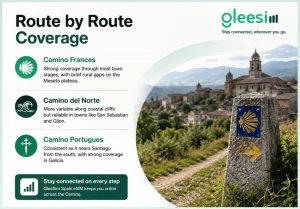
Spain hosts several established pilgrim routes into Santiago, the Camino Frances being the most walked, the Camino del Norte tracing the northern coastline, and the Camino Portugues arriving from the south. Each passes through different terrain, which directly affects connectivity.
Coverage gap: a stretch of terrain with no partner network tower reach, common on the Meseta plateau between Burgos and Leon, and a well-known feature of the route rather than an unusual occurrence.
Most pilgrims walking the full Camino Frances take around five weeks at a pace of roughly 20 to 25 kilometers a day, so planning a data allowance around a month or more, with the option to top up, tends to work better than estimating a smaller amount upfront.
Activating your GleeSim Spain eSIM over WhatsApp before you fly means you land with data ready, no searching for a shop in Saint-Jean-Pied-de-Port or Irun on day one.
| Route | Terrain | Coverage |
| Camino Frances | Mixed, includes Meseta plateau | Strong in towns, gaps on Meseta |
| Camino del Norte | Coastal | Variable, strong in coastal cities |
| Camino Portugues | Rural to urban Galicia | Consistent, improves near Santiago |
Is the Meseta section really that empty on signal? It has more gaps than town stages, but most pilgrims report messaging apps still connect intermittently even in the quieter stretches.
Can I extend my plan if my walk takes longer than expected? Yes, message GleeSim on WhatsApp anytime for a top-up without needing to restart your setup.
Which route has the most reliable coverage overall? The Camino Portugues tends to offer the most consistent coverage given its shorter length and denser town spacing, though all three main routes are walkable with a standard travel eSIM.
Do albergues typically have wifi as a backup? Many do, though quality varies widely, which is part of why having a dependable data connection matters for route planning and messaging home.
Is one Spain eSIM enough if I start the walk in France? You would need to add France coverage separately for the French portion of the Camino, then rely on your Spain plan once you cross the border.
Prepare your Camino with the Spain destination page or buy at offers.gleesim.com.
Use code GLEE10 when purchasing via WhatsApp
No registration required Purchase as a guest Under 2 minutes Buy & manage directly via WhatsApp
Save 10% with GLEE10