Hajj is not merely a journey—it is a profound spiritual milestone that many Muslims prepare for over a lifetime.
In anticipation of this sacred pilgrimage, I dedicated considerable time to preparation. I attended seminars, studied the rituals in detail, organised my travel arrangements, and ensured all documentation was in order. By all conventional measures, I felt fully prepared.
Flights were confirmed.
Accommodation was secured.
Spiritual readiness was ongoing.
However, I overlooked one critical aspect: reliable mobile connectivity in Saudi Arabia.
I assumed that occasional hotel Wi-Fi or international roaming would suffice. In reality, this assumption proved to be one of the most challenging oversights of my journey.
Upon arrival in Makkah, the scale and intensity of Hajj became immediately apparent. Millions of pilgrims move simultaneously between sacred sites, following tightly scheduled rituals.
In such an environment, communication and navigation are essential.
Without consistent internet access, even simple tasks became unnecessarily difficult.
During Tawaf, I was briefly separated from my group. In a matter of seconds, I found myself alone within a vast crowd.
I attempted to contact them.
There was no internet connection.
Messages would not send.
Location sharing was unavailable.
This situation caused genuine concern. In such a setting, the ability to communicate is not merely convenient—it is vital.
Travelling between Mina, Arafat, and Muzdalifah requires accurate navigation and timing.
Without access to live maps:
My group leader was sharing essential updates regarding movement schedules and meeting points. Without connectivity, I missed several of these communications, which led to confusion and avoidable stress.
In an attempt to remain connected, I briefly enabled international roaming. The associated costs escalated quickly and unpredictably, making it an impractical solution.
At this point, I recognised a key insight:
Reliable internet access is an essential component of modern Hajj preparation.
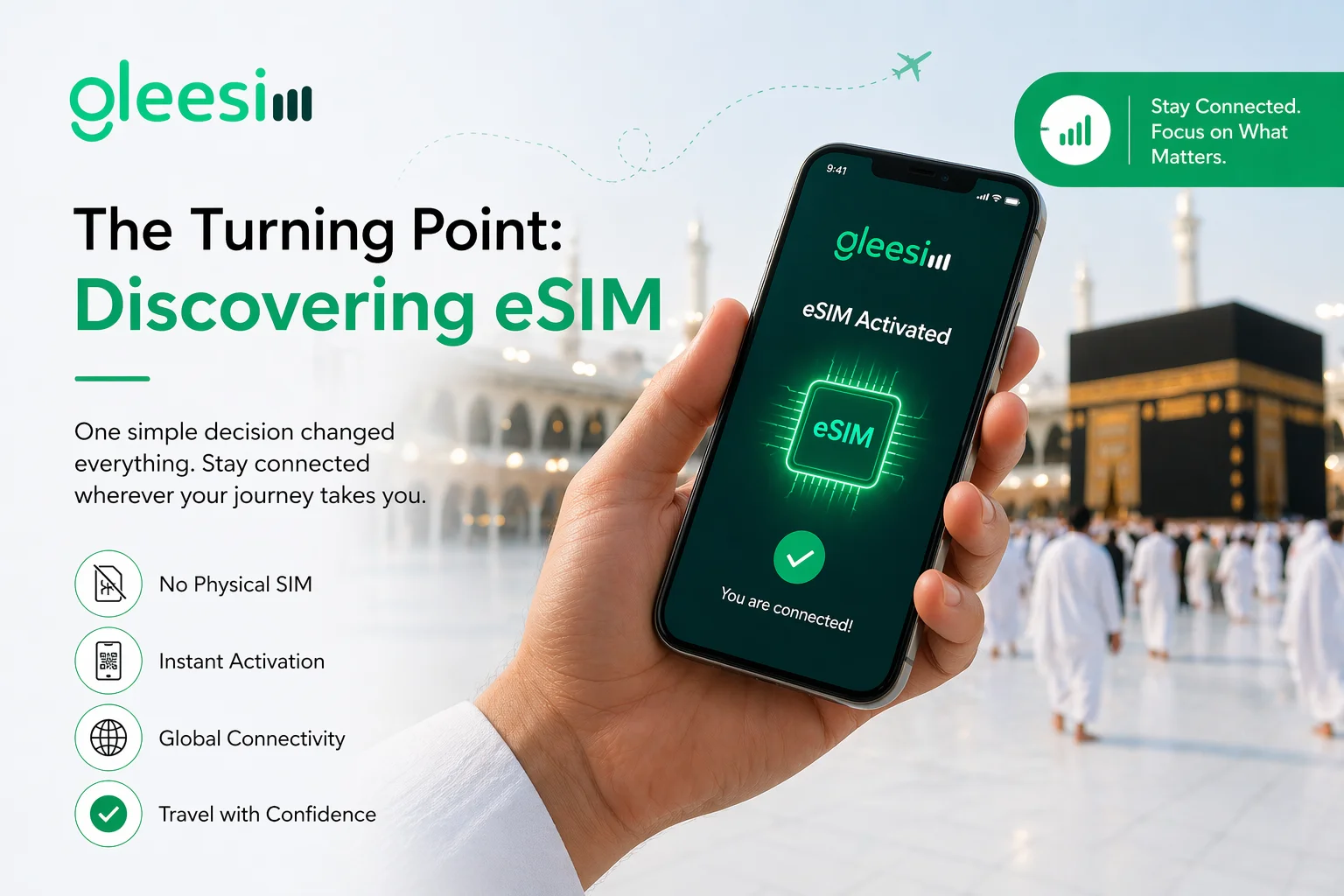
Later, I encountered a fellow pilgrim who appeared notably organised and consistently connected. He recommended using an eSIM solution.
After conducting brief research, I discovered GleeSIM, which offers a streamlined digital connectivity solution designed for travellers.
👉 https://offers.gleesim.com/offer-detail/1448465/esimVault
Given the simplicity of the process, I decided to proceed.
This decision significantly improved my experience.
An eSIM is a digital SIM card embedded within your device, allowing you to activate a mobile data plan without inserting a physical SIM.
The process is straightforward:
With GleeSIM, the entire setup can be completed online prior to departure.
Once the eSIM was activated, the improvement was immediate and substantial.
Within minutes, I had access to stable mobile data. This eliminated the need to rely on public Wi-Fi networks.
👉 https://offers.gleesim.com/offer-detail/1448465/esimVault
Access to real-time navigation tools allowed me to move confidently between locations. Google Maps functioned seamlessly, reducing uncertainty and saving time.
The ability to reconnect with my group brought considerable reassurance.
Using messaging applications, I was able to:
Reliable internet access enabled me to manage transport arrangements, monitor schedules, and access essential services without difficulty.
Unlike roaming services, the eSIM provided a prepaid structure with clear data usage. This ensured there were no unexpected charges.
👉 https://offers.gleesim.com/offer-detail/1448465/esimVault
Hajj presents unique logistical challenges due to its scale and intensity. Technology solutions must therefore be reliable, simple, and efficient.
GleeSIM is designed to meet these requirements.
Key advantages include:
Based on my experience, the following recommendations may assist future pilgrims:
Install and configure your eSIM prior to travel to avoid complications upon arrival.
👉 https://offers.gleesim.com/offer-detail/1448465/esimVault
Create group chats for communication and enable location sharing for better coordination.
Ensure access to navigation tools, official pilgrimage applications, and communication platforms.
Carry a power bank, as your mobile device becomes an essential tool throughout the journey.
Airport kiosks often involve long waiting times and limited options. Pre-installed eSIMs eliminate this inconvenience.
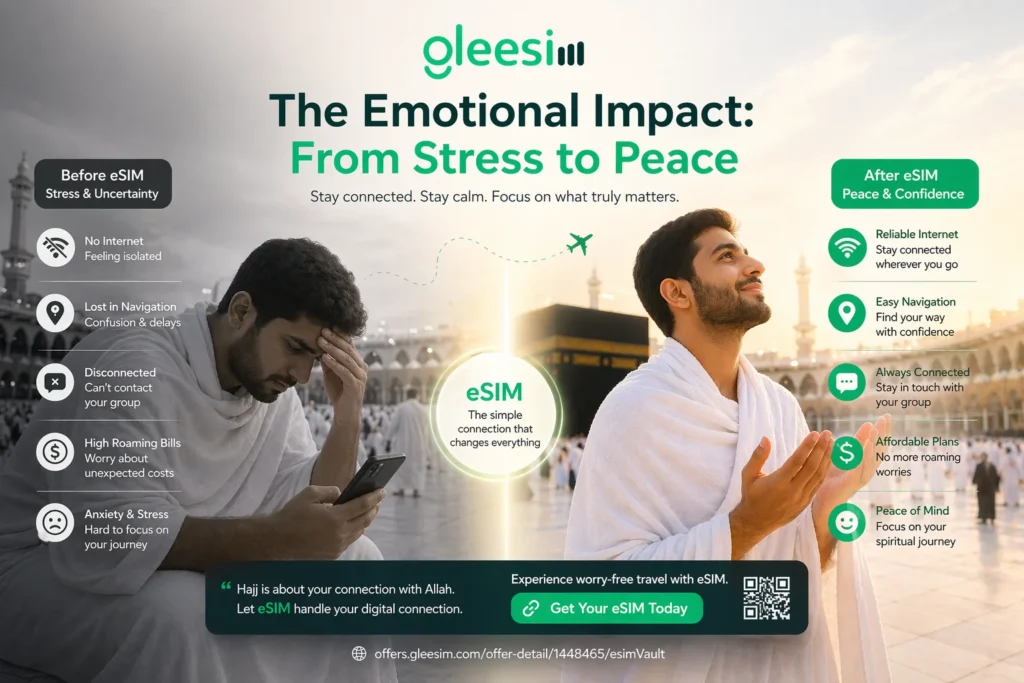
Before using the eSIM, I experienced:
After activation with GleeSIM, the experience changed significantly:
Most importantly, I was able to focus on the spiritual purpose of Hajj without avoidable distractions.
Reliable connectivity is no longer optional during Hajj—it is a practical necessity.
A simple decision, such as activating an eSIM before travel, can prevent:
To ensure a smooth and well-prepared experience:
👉 https://offers.gleesim.com/offer-detail/1448465/esimVault
👉 https://gleesim.com
A small preparation can make a significant difference.
An eSIM is a built-in digital SIM that allows you to activate a mobile data plan instantly by scanning a QR code, eliminating the need for a physical SIM card.
Yes. Most modern smartphones support dual SIM functionality, enabling you to use your primary SIM for calls and the eSIM for data.
Yes. **GleeSIM offers stable connectivity across key pilgrimage areas.
Yes. It allows immediate activation, avoids queues, and provides a more convenient experience.
The process typically takes less than five minutes.
Yes. The eSIM uses prepaid data, eliminating the need for expensive international roaming.
Yes. It can be installed in advance with assistance, making it simple to use during travel.
Additional data can be purchased بسهولة through the same platform:
👉 https://offers.gleesim.com/offer-detail/1448465/esimVault
Most recent devices support eSIM, but it is advisable to verify compatibility beforehand.
It supports navigation, communication, coordination, and access to essential services, contributing to a safer and more organised experience.