
Most travelers heading to Rio de Janeiro underestimate their data use by half, then spend day four of the trip hunting for WiFi in a beachside cafe instead of enjoying Copacabana. This guide will walk you through exactly how much data a week in Rio actually takes, broken down by activity, so you can pick the right plan before you land and skip that problem entirely.
Rio is a city built for phone use. Between the hills, the beaches, and the sheer size of the metro area, you will lean on your phone constantly, and each activity below pulls from your data allowance differently.
Maps and navigation: Google Maps in a dense city like Rio, with constant rerouting through hills and traffic, uses roughly 5 to 10 MB per hour of active navigation. Rio’s terrain means your route often changes mid walk, which triggers more rerouting than a flat, grid style city.
Ride hailing apps: Uber and 99 (Brazil’s local ride app) use very little data per trip, usually under 5 MB, but you will open them often, especially at night when walking between neighborhoods isn’t the safest option.
WhatsApp voice and video calls: A 10 minute WhatsApp video call to family back home uses around 150 to 200 MB. Voice only calls use a fraction of that, closer to 5 to 10 MB for the same duration.
Social media and photo uploads: Posting a handful of Instagram Stories or photos from Sugarloaf Mountain or Ipanema Beach each day can easily add up to 200 to 400 MB daily if you’re uploading in high quality. Video clips push that number considerably higher.
Streaming: Music streaming while walking the boardwalk runs about 40 to 60 MB per hour on standard quality, more if you’re on a higher fidelity setting.
Translation apps: If you don’t speak Portuguese, apps like Google Translate’s camera and conversation modes use small amounts of data per use, but frequent use throughout the day adds up.
Food delivery and restaurant apps: Checking menus, tracking orders on apps like Rappi, and browsing reviews before choosing where to eat all draw modest but steady amounts of data.
Data allowance, in the context of a travel eSIM, refers to the total amount of mobile internet you can use before your plan either slows down or requires a top up. It is measured in gigabytes (GB), and unlike a home broadband connection, it does not reset daily. It’s a fixed pool for the length of your plan, so pacing your heaviest usage days (arrival, departure, and any day you’re posting a lot of content) against lighter beach days helps you stretch a smaller plan further.
| Activity | Daily Use (Light) | Daily Use (Heavy) |
| Navigation & ride hailing | 50 MB | 150 MB |
| WhatsApp calls | 100 MB | 400 MB |
| Social media & photos | 150 MB | 500 MB |
| Streaming music | 100 MB | 300 MB |
| Translation & food apps | 30 MB | 80 MB |
| Daily Total | ~430 MB | ~1.43 GB |
| 3 Day Total | ~1.3 GB | ~4.3 GB |
| 7 Day Total | ~3 GB | ~10 GB |
| 14 Day Total | ~6 GB | ~20 GB |
If you’re a light user who mostly relies on hotel WiFi in the evenings, a 5GB plan comfortably covers a week, with some room to spare. If you’re constantly navigating, calling home, and posting content throughout the day, lean toward the 10GB option, and if your trip stretches past two weeks or combines Rio with other Brazilian cities, the 90 day plan gives you the flexibility to keep going without worrying about expiry.
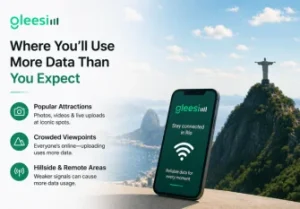
A few Rio specific moments tend to spike data u
se beyond what a typical city trip involves. Christ the Redeemer and Sugarloaf Mountain both draw huge crowds who are simultaneously trying to upload photos and videos from the same viewpoints, which doesn’t slow your own data allowance but does mean you’ll likely be uploading more content than usual in those moments. Similarly, if you’re taking a favela tour or visiting Rocinha, spotty coverage in some hillside areas can mean your phone works harder (and drains more battery and occasionally more data through retry attempts) trying to maintain a signal.
GleeSim’s Brazil eSIM plans come in three sizes built around exactly this kind of usage pattern: a 5GB 30 day plan for lighter, shorter trips, and 10GB options across 30 or 90 days for heavier use or longer stays. Since the eSIM is managed entirely through WhatsApp, checking how much data you have left mid trip is as simple as sending a message, no app, no dashboard, no guesswork. This matters more than it might seem on a Rio trip specifically, since you’ll want to know your remaining balance before deciding whether to livestream the sunset from Arpoador or save that data for later.
Getting your eSIM active before your flight takes only a few minutes. Our full activation walkthrough covers the exact steps for both iPhone and Android, so you can scan your QR code at home and land already connected, ready to coordinate your airport transfer the moment you clear customs at Galeão International Airport.
Does watching Netflix in the hotel count against my eSIM data? Yes, if you’re using your eSIM’s mobile data rather than hotel WiFi. Streaming video is the single biggest data drain, so switch to WiFi where available and save your eSIM data for when you’re out and about.
Will my data run out faster in Rio than in a quieter destination? Not because of the network itself, but because you’ll likely use your phone more often for navigation, translation, and ride hailing in a busy city, so your realistic daily use tends to run higher than in a slower paced destination.
Can I top up mid trip if I run low? Yes. Send a WhatsApp message to GleeSim support and we will add data directly to your active eSIM profile within minutes, no new plan or physical shop required.
Does hillside terrain in Rio affect my signal at all? In some of the steeper, more remote favela areas, signal can be weaker, but across the main tourist areas (Copacabana, Ipanema, Leblon, Santa Teresa, and central Rio) coverage from Brazil’s major networks is consistently strong.
Should I buy my data plan before I land or wait until I arrive? Buy and activate it before you fly. Setting your eSIM up in advance using our activation guide means you land already connected, rather than losing your first hour in Rio searching for WiFi to get set up.
Is 5GB really enough for a week, or am I likely to run out? For a light user relying on hotel WiFi in the evenings, 5GB is genuinely enough. If you’re unsure, the 10GB plan gives you a safety margin for a small price difference, and any unused data simply isn’t wasted since GleeSim plans don’t penalize you for using less than you bought.
Ready to land in Rio already connected? Get your GleeSim Brazil eSIM before you fly and skip the airport SIM kiosk entirely.