You send a WhatsApp message to your caravan group and watch the single tick sit there. Not two ticks. Just one. For fourteen minutes.
Then it goes through. Then the next one takes four seconds. Then the one after that sits undelivered for half an hour. This is what internet in Karbala during Arbaeen actually feels like, and no travel guide prepares you for it adequately because the experience changes year to year and hour to hour.
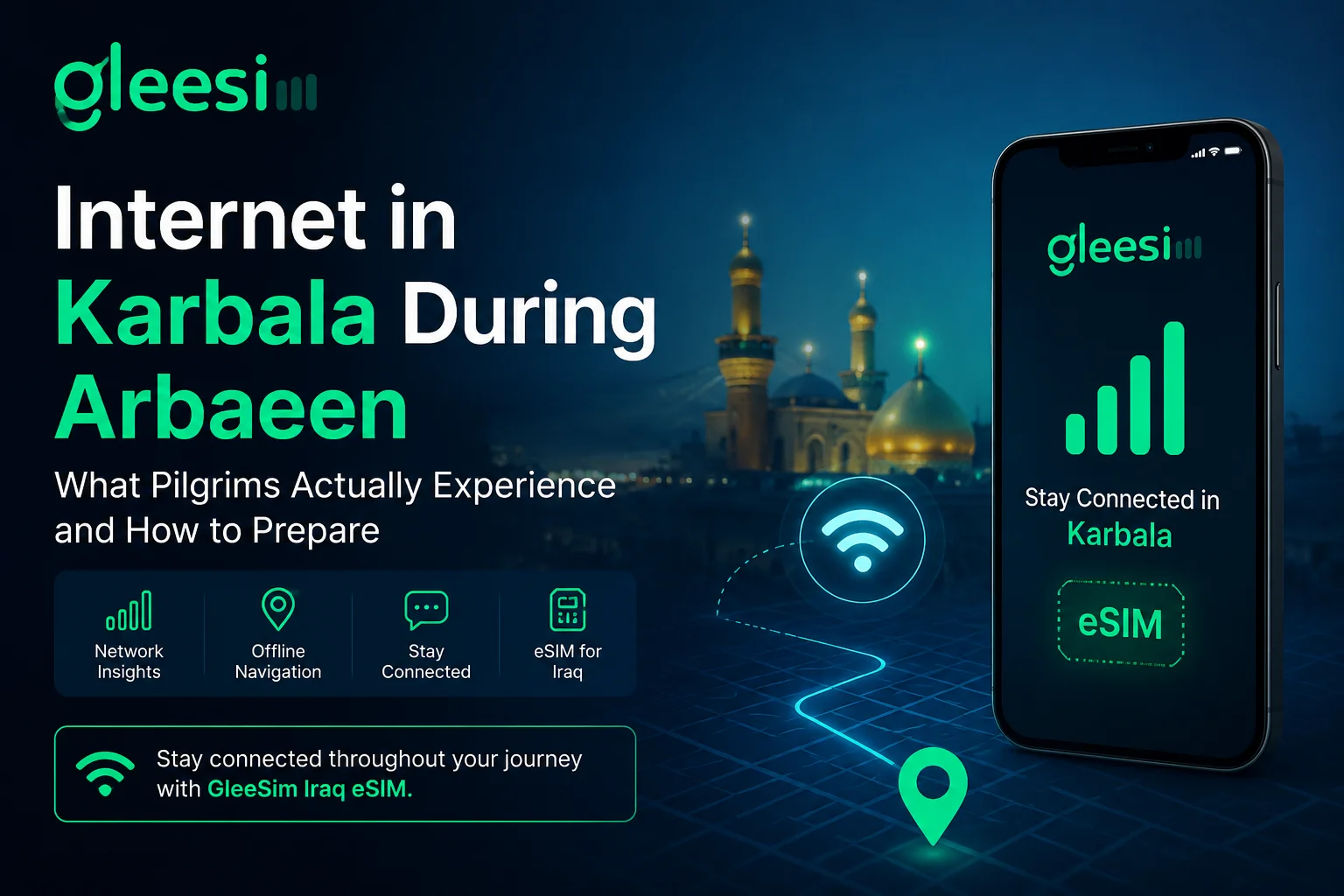
This article will give you an honest picture of what connectivity is like in Karbala during Arbaeen, what causes the disruptions, when they are worst and when they ease, and exactly how to prepare so that a congested network does not cost you a lost group member, a missed family call, or a panicked hour without navigation.
Arbaeen is the largest annual human gathering on earth. In recent years, between fifteen and twenty million people have converged on Karbala within a window of seventy-two hours. Every one of those people has a smartphone. A significant proportion are simultaneously trying to share photos, send voice notes, make WhatsApp calls, and load navigation maps.
The mobile networks in Karbala are not built for twenty million simultaneous users. Nobody’s networks are. What the Iraqi operators (primarily Asiacell and Zain Iraq) have done over recent years is deploy additional temporary infrastructure including mobile cell-on-wheels units and portable base stations positioned along the main approach routes. This helps. It does not solve the problem.
The result is an experience that is entirely different from what your SIM card or eSIM delivers on any other day in any other city. Understanding that gap in advance is the most useful preparation you can do.
The connectivity experience during Arbaeen is not uniformly bad. It fluctuates significantly based on location, time of day, and proximity to the shrine.
Days before Arbaeen (arrival period): Connectivity in Karbala is generally good during the two to three days before the main gathering. Networks are running at elevated but manageable load. WhatsApp calls, navigation, and media sending all work relatively normally. This is the window to download everything you need offline.
The walk from Najaf to Karbala: Network quality along the 80 km procession route varies dramatically by section. Urban stretches near Kufa and the outskirts of Karbala have reasonable 4G coverage. The rural middle sections of the route, particularly between the 30 km and 60 km markers from Najaf, have known dead zones where even basic voice SMS may not push through. WhatsApp delivery ticks often freeze here for hours at a time.
The final approach to the shrine (highest congestion): The area within two to three kilometres of the Imam Hussein (AS) shrine during the final hours of Arbaeen is the most congested telecommunications environment most pilgrims will ever experience. Peak congestion here makes data transmission unreliable across all operators. WhatsApp audio messages often fail to send for thirty minutes to several hours. Live calls are almost impossible to sustain. Text-only SMS over the cellular voice channel (not data) is often the most reliable communication method during this specific window.
After Arbaeen (dispersal): As pilgrims begin leaving Karbala in the twenty-four to forty-eight hours after the main gathering, connectivity recovers relatively quickly. Dispersal happens across multiple routes simultaneously, which reduces congestion at any single point. Most pilgrims find that WhatsApp messaging returns to normal functionality within twelve to eighteen hours of the peak crowd moment.
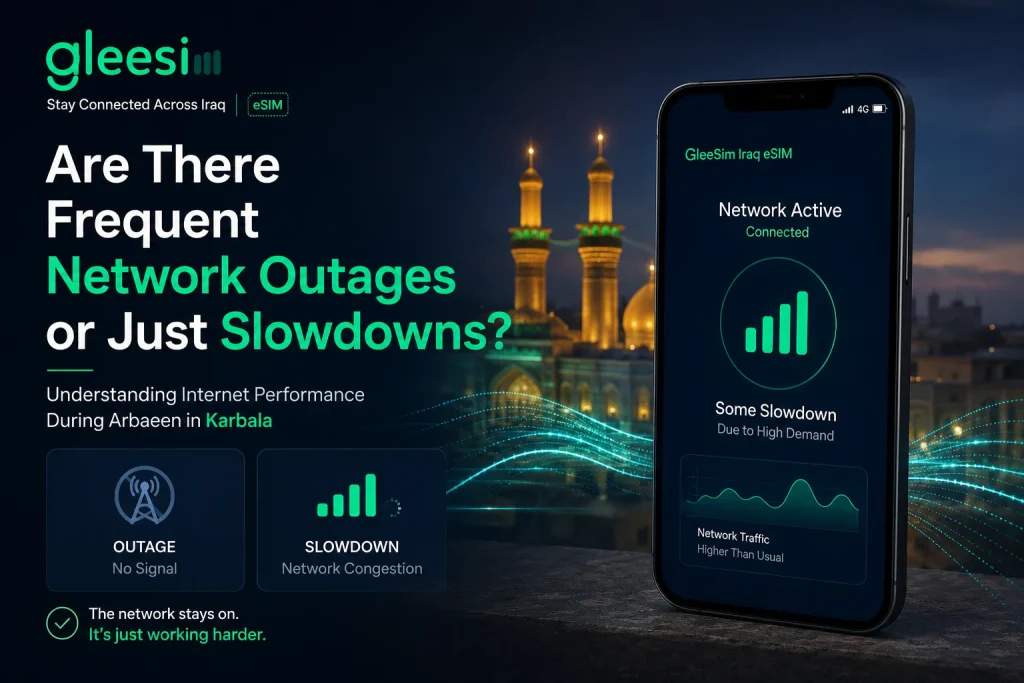
This is an important distinction. The Arbaeen connectivity experience is primarily severe congestion rather than complete outages. The network does not go down in the sense that towers stop functioning. What happens instead is that so many devices are competing for the same limited radio capacity that each individual connection receives only a fraction of its normal bandwidth.
How mobile networks fail under congestion: Each cell tower has a fixed capacity measured in simultaneous connections and total data throughput. When that capacity is exceeded, the tower does not stop working. It instead serves each connected device progressively less bandwidth. A tower designed for 500 simultaneous connections serving 5,000 gives each user roughly one-tenth of their normal allocation. At 20,000 simultaneous connections, the share drops to a point where even a text WhatsApp message may take minutes to transmit.
This means your data connection during Arbaeen peak hours is not off. It is simply extremely slow. Understanding this distinction helps you make better decisions about when to try sending messages versus when to accept that it will have to wait.
What typically gets through during peak congestion:
– Plain text WhatsApp messages (low data, eventually deliver)
– SMS over cellular voice channel (uses a different network layer)
– Basic voice calls if you have Asiacell or Zain and are on a less congested tower
What typically does not get through during peak congestion:
– WhatsApp voice calls (require sustained bandwidth)
– WhatsApp video calls (require significantly more bandwidth)
– Photo or video sending
– Live map loading or navigation data refresh
– Any streaming content
This question matters more for Arbaeen than for a regular Ziyarah trip because the stakes of being unreachable are higher when you are in a crowd of twenty million people.
| Factor | Local Asiacell/Zain SIM | International eSIM (GleeSim) | Pakistani/UK Roaming SIM |
| Coverage at shrine | Strongest (direct network) | Good (via roaming partner) | Variable (depends on roaming deal) |
| Congestion experience | Same as all users on that network | May route through different network capacity | Same as roaming partner network |
| Pre-arrival active | No | Yes | Yes |
| Cost during Arbaeen | Low (local bundle) | Competitive | Potentially high |
| Plan top-up during Arbaeen | Via USSD if data fails | Via WhatsApp | Contact home carrier |
The honest answer is that no SIM or eSIM gives you immunity from Arbaeen congestion. Every device in Karbala during peak hours is sharing the same towers regardless of which carrier they use or where they purchased their plan. The advantage of a local Asiacell SIM is that it accesses the network that has the most towers in Karbala, giving a marginal advantage in coverage reach. The advantage of a GleeSim Iraq eSIM is that it is active before you land and can be managed throughout the journey via WhatsApp without needing to visit a dealer.
Many experienced Arbaeen pilgrims carry both. A local Asiacell SIM as primary and a GleeSim eSIM as a secondary line on a dual-SIM phone. When one network’s congestion is worst, there is a chance the other path finds slightly more capacity.
This comparison is simpler than it sounds because public Wi-Fi availability during Arbaeen is extremely limited in the areas that matter most.
| Location | Wi-Fi Available | Reliable | Useful For |
| Near the shrine (peak Arbaeen) | Minimal | No | Do not rely on it |
| Arbaeen route (procession path) | Some Mawakib tents | Very unreliable | Not suitable for critical comms |
| Karbala city hotels | Yes | Moderate | Evening tasks at accommodation |
| Mawakib service stations | Occasional hotspots | Variable | Emergency backup only |
| Baghdad airport (on return) | Yes | Good | Final communication before boarding |
The pattern for Arbaeen specifically: mobile data, despite its congestion, is more consistently available than public Wi-Fi throughout the procession route and shrine area. Wi-Fi requires you to be within range of a specific access point, which is difficult to guarantee in a moving crowd of millions. Mobile data follows you wherever cellular coverage exists.
Use hotel Wi-Fi in the evenings for heavy tasks. Use mobile data (even slow, congested mobile data) as your communication layer during active pilgrimage hours.
This comparison comes up often among pilgrims who have attended both gatherings, and the honest answer is nuanced.
Hajj connectivity advantages: Saudi Arabia has invested heavily in telecommunications infrastructure specifically for Hajj. Masjid al-Haram and the surrounding areas in Mecca and Mina have dedicated high-density 4G and 5G deployments from Saudi Telecom (STC) and Zain Saudi Arabia, calibrated for the specific footprint of Hajj movement. The Saudi government coordinates with operators years in advance on capacity planning. As a result, WhatsApp messaging and basic communication during Hajj, while still congested, generally performs better than during Arbaeen peak hours.
Arbaeen connectivity context: Iraq has fewer years of experience managing twenty-million-person connectivity events and less pre-existing infrastructure in the Karbala area. The Iraqi operators have improved significantly year over year, adding temporary towers, deploying mobile units along the procession route, and coordinating government support during the event. But Arbaeen’s geographic concentration, with the final crowds compressed into a very small area around the shrine, creates a density challenge that remains harder to solve than Hajj’s more distributed geography.
The practical implication: If you have attended Hajj and were frustrated by connectivity limitations there, expect Arbaeen in Karbala to present a noticeably more challenging connectivity environment during the peak twenty-four-hour window near the shrine. If you have not attended Hajj, plan for Arbaeen connectivity to be more limited than anything you have likely experienced at a domestic event or a regular Ziyarah trip to Karbala.
5G deployment in Karbala is at an early stage. Asiacell and Zain Iraq have both announced 5G trials and rollouts in Iraq, but these deployments are concentrated in Baghdad city centre and specific commercial zones. Karbala, outside of its city centre, does not have meaningful 5G coverage at the time of writing.
During Arbaeen specifically, your phone will operate on 4G LTE (or 3G in the most congested zones where your phone downgrades to maintain any connection at all). 5G is not a factor in current Arbaeen connectivity planning.
| Technology | Karbala City (Normal) | Karbala Shrine Area (Arbaeen Peak) | Procession Route |
| 5G | Not available | Not available | Not available |
| 4G LTE | Available (Asiacell, Zain) | Severely congested | Variable, good to dead |
| 3G UMTS | Available as fallback | More reliable than 4G under extreme load | Patchy |
| 2G GSM | Available (voice/SMS) | Most reliable layer for text SMS | Widely available |
There is an important counterintuitive point in this table. During extreme congestion, 3G or even 2G connections for basic SMS can sometimes perform more reliably than 4G for text communication. This is because the 2G/3G voice channel uses different radio resources than the 4G data channel, and SMS routes through the voice network rather than the data network. When your 4G data is completely saturated, sending a plain text SMS to confirm your location can go through while WhatsApp data messages queue indefinitely.
This is the question that matters most emotionally for Arbaeen pilgrims, and it deserves a practical answer rather than a vague reassurance.
Strategy 1: Pre-agreed check-in schedule Agree on specific check-in times with family before you leave. If you will send a WhatsApp message or audio note at 8am, 2pm, and 8pm local Iraq time, family knows when to expect communication and when not to worry if they have not heard from you for several hours. Congestion-driven radio silence becomes significantly less alarming when it is expected within a pre-agreed framework.
Strategy 2: Send text before audio or photo During congested periods, send a short text message before trying to send audio or photos. If the text goes through (two blue ticks), the data path to your contact is open and audio will likely follow. If the text stays on one tick for more than ten minutes, conserve your battery and try again later rather than retrying repeatedly.
Strategy 3: Use SMS as an emergency fallback Save your family’s phone numbers as standard contacts, not just WhatsApp contacts, so you can send a plain SMS if WhatsApp data fails entirely. SMS routes through the 2G voice channel rather than the data network and often gets through when WhatsApp cannot. A short SMS saying “I am fine, at the shrine” costs almost nothing and provides the update that matters most.
Strategy 4: Live location when connected, screenshots when not If you have a data connection, WhatsApp Live Location shared with your caravan group coordinator is the most efficient safety tool available. When you lose data, take a screenshot of your last known GPS position on your offline map and send it as an image the next time connectivity is available.
The honest answer: not reliably, and not in the locations where you need them most.
Some Mawakib (pilgrim service caravans) along the Najaf-to-Karbala procession route offer Wi-Fi as part of their services. These spots are inconsistent in quality, heavily shared among hundreds of passing pilgrims, and not guaranteed to be present at any specific point on the route year to year. They are useful for a quick message when you happen to be resting at a caravan that has one, but should not be planned around.
Near the shrine complex itself during Arbaeen peak hours, the combination of extreme crowd density and the large number of people sharing any Wi-Fi access point makes these connections even less useful than the congested cellular network.
If you are staying in a hotel in Karbala city, that hotel’s Wi-Fi in the evenings is your most reliable Wi-Fi source during an Arbaeen trip. Use it for the heavy tasks listed in the preparation section below.
Will my international phone work in Karbala during Arbaeen or should I buy a local SIM?
Your international phone will work. All modern smartphones connect to Iraqi networks on arrival. The question is which data source gives you the best experience under Arbaeen congestion. A local Asiacell SIM provides the most direct access to Karbala’s network infrastructure. A pre-activated international eSIM from GleeSim gives you coverage before you land plus WhatsApp-based plan management throughout. Many experienced pilgrims use both on a dual-SIM phone.
Are there frequent network outages or severe slowdowns during the Arbaeen crowds?
The primary experience is severe congestion rather than full outages. Towers continue to function but serve each connected device a fraction of normal bandwidth. During peak hours within two kilometres of the shrine, WhatsApp voice calls and media sending may be effectively unusable for extended periods. Text messages and SMS still push through, though slowly.
What apps and offline resources should I download before traveling to Karbala for Arbaeen?
Download Google Maps offline for Karbala and Najaf, Maps.me with the Iraq country file, your Quran and Ziyarah dua app with offline content, and any audio recitations you want access to without data. Download the Arbaeen procession route offline specifically. Save your caravan coordinator’s number, emergency contacts, and your hotel address as text in a note app that works without internet.
How can pilgrims keep in touch with family when mobile networks are congested?
Use a pre-agreed check-in schedule so family knows when to expect contact and when silence is planned rather than alarming. Send text WhatsApp messages before trying audio or photos. Use plain SMS as a fallback when WhatsApp data fails entirely. Share WhatsApp Live Location when connected and send map screenshots when offline.
Are there reliable public Wi-Fi spots at the shrine area or pilgrim camps?
Not reliably. Some Mawakib along the procession route offer shared Wi-Fi, but quality is highly variable. Near the shrine during peak Arbaeen hours, public Wi-Fi where it exists is shared among thousands of users and is not dependable for critical communication. Your hotel Wi-Fi in the evenings is the most reliable alternative to mobile data.
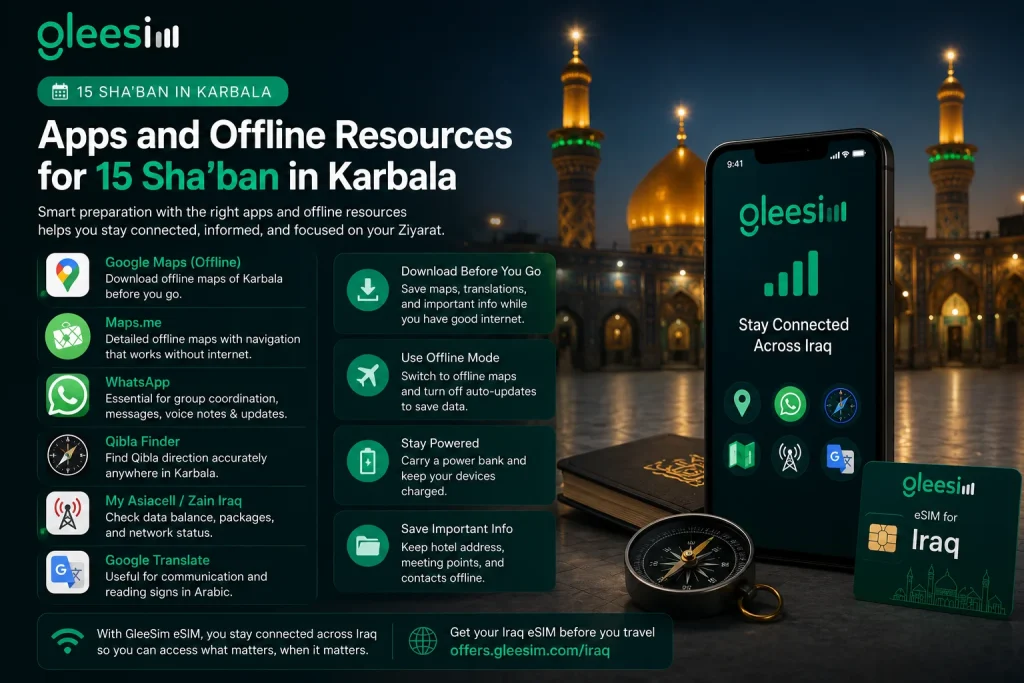
Your preparation window is at home, or at your Karbala hotel in the days before Arbaeen peak. Once the crowd density builds, your data connection will not support bulk downloads reliably.
Maps and navigation:
– Google Maps offline for Karbala, Najaf, and the procession route
– Maps.me with Iraq downloaded (covers shrine alleyways that Google Maps sometimes misses)
– Screenshot your hotel address and entrance pin to your camera roll
Ziyarah and religious content:
– Quran app with Arabic text and your preferred recitation downloaded offline
– Mafatih app with Arbaeen and Ziyarah supplications downloaded
– Ziyarah Ashura and Arbaeen duas saved as text in a notes app as a zero-connectivity backup
Communication preparation:
– All caravan contacts saved as named phone contacts, not only WhatsApp contacts
– Emergency numbers saved locally (Iraqi police: 104, Ambulance: 122, Karbala Health: +964 32 3331111)
– Your tour operator’s WhatsApp and phone number saved both ways
– Your country’s embassy in Baghdad saved as a contact
GleeSim eSIM confirmation: If you are using a GleeSim Iraq eSIM, confirm it is active and functioning in the days before Arbaeen rather than the day of the peak gathering. Testing your connection under normal Karbala conditions before the crowd builds is the right time to resolve any issues via WhatsApp support.
The 80 km procession route from Najaf to Karbala is the central feature of Arbaeen for millions of pilgrims. Your GPS works without data. Your offline map shows your position without data. This combination means navigation does not require connectivity at all, as long as you prepared before you entered the route.
Google Maps offline setup for the procession route: Open Google Maps at home or at your accommodation before the walk. Search for the route from Najaf to Karbala. Save your start point (near Masjid Kufa or wherever your caravan begins) and your destination (Imam Hussein shrine) as offline-accessible favourites by starring them. Then download the offline map region that covers the full route. This download requires a strong Wi-Fi connection and roughly 200 to 400 MB of storage.
What offline maps cannot do: Real-time traffic updates, live road closures, and crowd density information all require data. Your offline map shows static road layouts and your current GPS position. It will not tell you which sections of the route are currently most congested or where temporary path changes have been made by event organisers. For this information, caravan group coordination on WhatsApp (when data is available) or physical coordination with Mawakib staff on the route is your source.
Connectivity preparation is useless if your phone is dead by midday on the walk. Battery management during Arbaeen is as important as data management.
Power bank recommendations: A 10,000 mAh power bank provides roughly two full charges for a standard smartphone and is light enough to carry throughout the walk. A 20,000 mAh bank covers three to four charges and handles a full multi-day walking period with margin. For pilgrims walking the full three to four days from Najaf, two power banks or one 20,000 mAh bank is the practical minimum.
Charging stations along the route: Mawakib service caravans along the Najaf-to-Karbala route typically offer phone charging facilities alongside food and rest areas. These are genuinely available and used by millions of pilgrims each year. They are also crowded and involve waiting time. Do not plan your charging strategy entirely around Mawakib stations. Carry enough power bank capacity to be independent between charging opportunities.
Settings that meaningfully extend battery during the walk:
– Enable Low Power Mode (iPhone) or Battery Saver (Android) from the start of each walking day, not when the battery warning appears
– Reduce screen brightness to 20 to 30 percent in daylight
– Turn off Wi-Fi scanning if you are not near any Wi-Fi (your phone drains battery searching for networks that do not exist on the procession route)
– Switch from live navigation to offline GPS position display, which consumes less battery than active routing
– Disable unnecessary notifications for apps other than WhatsApp and your primary communication channels
If you do connect to a Mawakib or public Wi-Fi spot along the route or near the shrine, basic security awareness applies.
Public Wi-Fi in high-density pilgrimage environments is unsecured and shared. Do not access banking apps, enter passwords, or conduct financial transactions on public Wi-Fi in Karbala during Arbaeen. Stick to WhatsApp messaging, which has end-to-end encryption by default, and avoid anything that requires logging in to an account with a password.
A VPN adds a layer of encryption over public Wi-Fi and is worth having installed before travel if you are security-conscious. Free VPN options exist but introduce their own privacy trade-offs. Paid VPN services (Mullvad, ProtonVPN) offer more trustworthy protection. Set up and test your VPN before travel, not on the procession route.
The most secure approach is simpler: use your mobile data for anything sensitive and reserve public Wi-Fi for low-stakes messaging only.
When your data connection is unreliable, you need methods that work with minimal bandwidth. Here is a hierarchy from lowest data requirement to highest.
Plain text SMS (no data required): A plain text SMS of under 160 characters uses the 2G voice channel, not the data network. Send: “At shrine, safe, will call tonight” to your family and this message will often go through when WhatsApp cannot. This is your absolute fallback layer and it requires zero data.
WhatsApp text message (very low data): A plain text WhatsApp message is extremely small in data terms, under 1 KB for a short message. These push through under congestion conditions that defeat media sending entirely. Agree a code word with your family before travel: “Green” means safe and on schedule, “Yellow” means delayed but fine, “Red” means need help. A single code-word WhatsApp message delivers the critical information in the smallest possible data packet.
WhatsApp audio message (low data): A one-minute voice note is approximately 0.5 to 1 MB. This is significantly smaller than a voice call, which requires sustained bandwidth. Sending a recorded audio message is more reliable under congestion than making a live call because it transmits as a file (which can be chunked and retried) rather than requiring a continuous connection.
WhatsApp Live Location (moderate data, very high value): If you have a working data connection, share your Live Location with your caravan coordinator and with a family member at home. This updates your position every few minutes and is the most efficient safety tool for the congested Arbaeen environment. Stop it when your data connection is unstable to avoid battery drain from failed update attempts.
The Arbaeen season is not the time to figure out your SIM situation for the first time. Here is the practical order of operations.
Before your flight (ideal): Activate a GleeSim Iraq eSIM via WhatsApp at least forty-eight hours before departure. Confirm it is working by testing data in the days before you travel. This gives you time to resolve any issues through WhatsApp support before you are standing in Najaf International Airport.
At the airport on arrival (if no eSIM): Asiacell and Zain Iraq have counters at Najaf International Airport (NJF) and Baghdad International Airport (BIAP). During Arbaeen season, these counters are heavily staffed and queues can be significant. Have your passport ready. Buy the thirty-day bundle rather than the seven-day bundle even if your trip is shorter. The per-day cost is lower and you will not need to manage a top-up during the most congested days of the journey.
In Karbala city (if you missed the airport): Licensed dealer shops near the shrine area and along Al-Abbas Street sell and top up SIM cards. Expect higher foot traffic during Arbaeen season. Bring your passport.
The clearest recommendation for first-time Arbaeen pilgrims: activate your GleeSim eSIM before you leave home, use it from the moment you land, and if your phone supports a second SIM, add an Asiacell physical SIM at the airport for maximum coverage resilience during peak congestion.
Browse Iraq eSIM data plans and activate yours over WhatsApp before your next Arbaeen trip at offers.gleesim.com/iraq.
This guide reflects general network conditions and pilgrim experiences based on publicly available information. Arbaeen connectivity conditions vary year to year based on operator investment, event scale, and government coordination. All practical advice should be treated as preparation guidance rather than guaranteed performance expectations. Emergency contact numbers should be verified before travel.