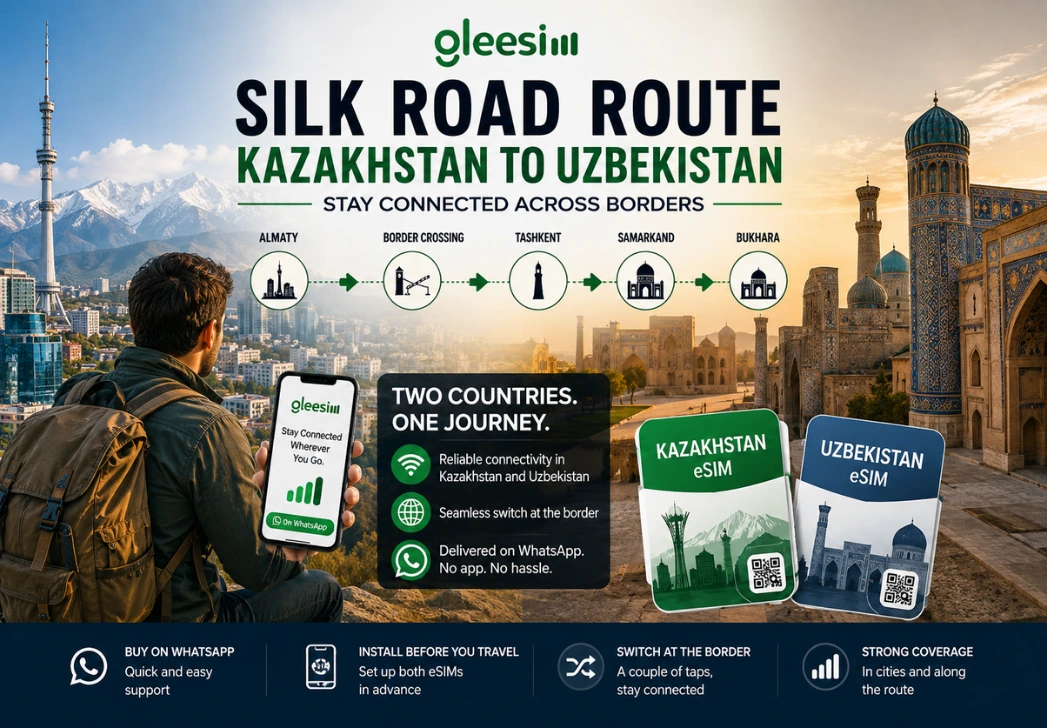
Are you planning a Silk Road route that crosses from Kazakhstan into Uzbekistan and wondering whether your phone will keep working the whole way? Central Asia’s old trade routes make for one of the more interesting overland trips available right now, but crossing a border here means crossing onto an entirely different mobile network too.
This article will help you understand how connectivity actually changes as you move between these two countries. After developing a complete understanding, you can make a better decision before you set off.
The route linking Almaty to Tashkent, often continuing on to Samarkand and Bukhara, follows some of the old Silk Road trading paths and has become a genuine draw for travellers interested in history without the crowds of Western Europe. It’s also increasingly popular with slower, overland style travellers who prefer trains and shared taxis to flights between cities.
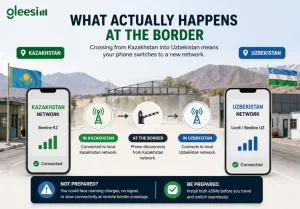
Cross border roaming, in this context, means your phone has to register on an entirely new country’s network the moment you cross, which usually triggers your home carrier’s most expensive roaming rate if you haven’t planned ahead.
The moment you cross from Kazakhstan into Uzbekistan, your phone drops the Kazakh network and searches for a local one. If you’re relying on a single-country SIM or a roaming plan not built for multi-country travel, this is exactly where connectivity problems start, often at a remote border crossing with no shop nearby to fix it.
Unlike travelling within one country, this specific route benefits from having connectivity sorted for both Kazakhstan and Uzbekistan before you leave home, rather than trying to arrange a local SIM at each border. Setting both up in advance means the transition from one country to the next is invisible rather than a scramble.
| Leg of the route | What to plan for |
| Almaty to the Kazakhstan-Uzbekistan border | Kazakhstan coverage |
| Crossing into Uzbekistan | Switch to Uzbekistan coverage |
| Tashkent, Samarkand, Bukhara | Uzbekistan coverage throughout |
Buy your Kazakhstan and Uzbekistan eSIMs separately on WhatsApp before departure, and install both while you’re still on home Wi-Fi. Each stays dormant until you’re actually in the relevant country, so there’s no cost sitting unused, and switching between them at the border takes a couple of taps in your phone’s settings.
Do I need two separate eSIMs for this route, or does one cover both countries? Kazakhstan and Uzbekistan are covered by separate country specific plans, so two eSIMs installed in advance is the practical approach for this route.
How do I switch between the two once I’ve crossed the border? Your phone’s settings let you set which installed eSIM handles your data, so switching is a quick manual change rather than anything automatic.
Is signal reliable at the actual border crossing? It can be patchy directly at the crossing itself, which is exactly why having both eSIMs installed and ready beforehand matters more than trying to sort it out on the spot.
Does this route work well by train, or is flying more practical? Both are common. Rail and shared taxi options exist along most of this corridor for travellers who prefer overland travel over domestic flights.
See GleeSim’s Kazakhstan eSIM page and GleeSim’s Uzbekistan eSIM page for current bundle pricing on both legs. When you are ready, get your bundles on offers.gleesim.com and cross the border already connected.