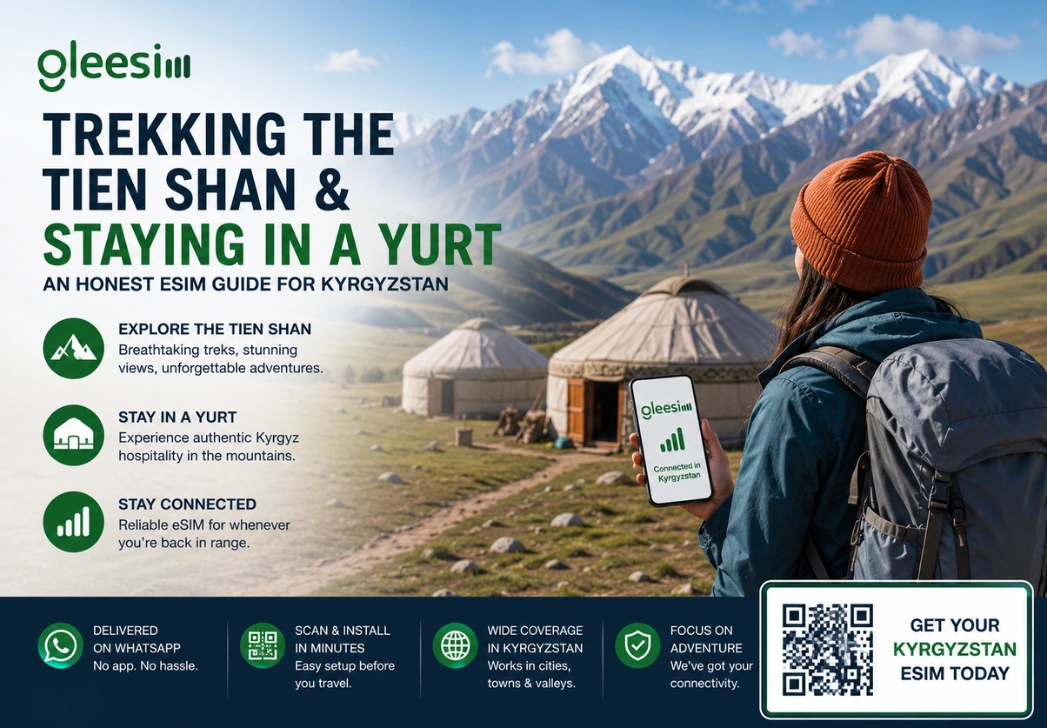
Are you planning to trek into the Tien Shan mountains or spend a few nights in a traditional yurt camp, and wondering what your phone will actually be able to do out there? Kyrgyzstan’s mountain interior is one of its biggest draws, and it’s also genuinely remote once you’re away from the main towns.
This article will help you understand what to expect from connectivity in Kyrgyzstan’s mountain regions. After developing a complete understanding, you can make a better decision on how to prepare.
Yurt camps and mountain treks in Kyrgyzstan often sit hours from the nearest town, reached by unpaved roads or on foot along trekking routes through the Tien Shan range. This is exactly the kind of setting where coverage exists in populated valleys but drops away across higher, more remote terrain.
Remote mountain coverage, in practical terms, means signal is generally reliable near towns like Karakol or Bishkek but becomes intermittent or absent once you’re deep into trekking routes or at higher altitude yurt camps away from any settlement.
Coverage near towns like Karakol, a common trekking base, is generally solid. Once you’re on multi-day trekking routes or staying at more remote yurt camps, expect signal to be patchy at best and often entirely absent, particularly at higher elevations or in valleys away from the nearest road.
| Location | What to expect |
| Bishkek and Karakol | Consistent 4G |
| Roads connecting towns | Generally reliable |
| Yurt camps near a road | Often reasonable |
| Remote trekking routes and high passes | Plan for no signal |

Download offline maps before you leave Karakol or Bishkek, since this is exactly the kind of trip where a maps app becomes useless the moment signal disappears. Share your planned route and expected return with someone before you set off, and treat any signal you do encounter along the way as a bonus rather than something to count on.
Even with real gaps in coverage during the trek itself, having connectivity ready for Bishkek, Karakol, and any towns along your route matters, both before you set off and once you’re back near civilisation. Set your eSIM up while you’re still in a town with a strong connection, so it’s ready for the moments coverage does return.
Will I have any signal while trekking in the Tien Shan mountains? Generally limited to none on remote routes and at higher elevations. Coverage is far more reliable near towns like Karakol.
Do yurt camps have Wi-Fi or mobile signal? It varies. Some closer to roads or towns have reasonable coverage, while more remote camps often have very little.
Should I hire a guide for trekking routes with no signal? Many travellers do, particularly for multi-day routes, since a local guide familiar with the terrain adds a layer of safety that connectivity alone can’t replace.
Does the same eSIM work in both Karakol and Bishkek? Yes, one Kyrgyzstan eSIM covers the whole country, wherever signal actually reaches.
See GleeSim’s Kyrgyzstan eSIM page for current bundle pricing. When you are ready, get your bundle on offers.gleesim.com and set it up before you leave town.