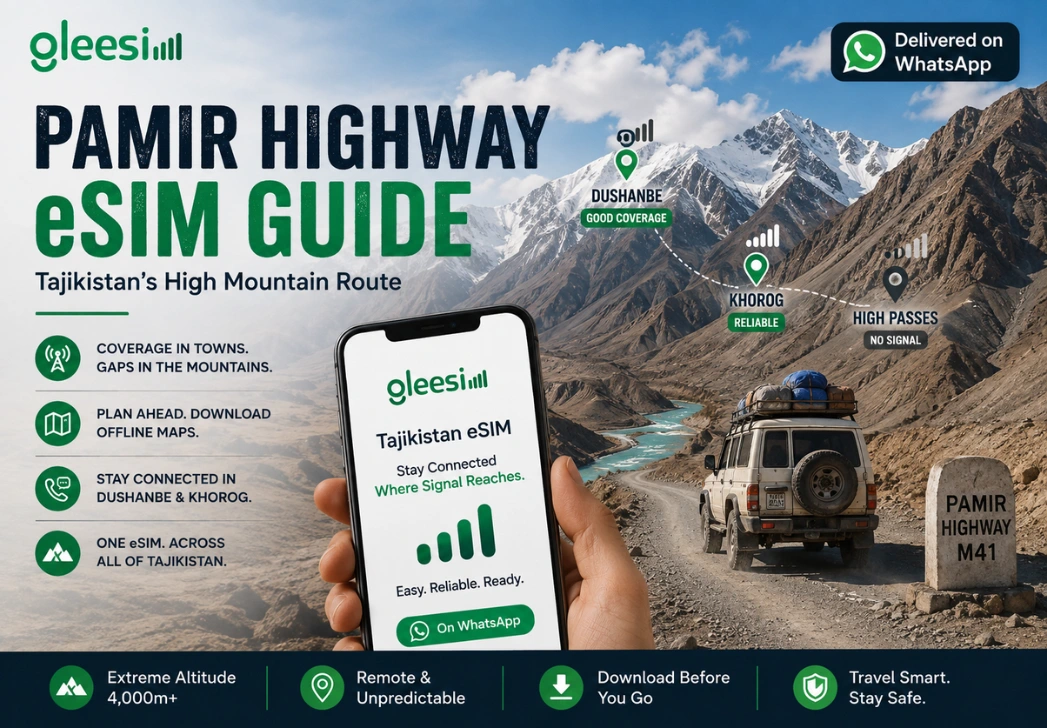
Are you preparing for the Pamir Highway and wondering what actually happens to your phone signal at altitude? This is one of the more remote overland routes anywhere in the world, and it deserves an honest answer rather than a blanket promise that everything just works.
This article will help you understand exactly where connectivity holds up on this route and where it doesn’t. After developing a complete understanding, you can make a better decision on how to prepare.
The Pamir Highway runs through some of the highest, most sparsely populated terrain accessible by road anywhere on earth, crossing passes well above 4,000 metres between Dushanbe and the Tajik-Kyrgyz border. Towns along the route are small and spread far apart, and mobile infrastructure follows that same pattern.
Signal thinning, in practical terms, means coverage that exists near towns and populated valleys but drops away across the empty high altitude stretches between them. This is a function of genuine remoteness, not a fault with any specific network or provider.
Coverage along the Pamir Highway is best understood as intermittent rather than continuous. Larger towns like Khorog generally have reliable signal. The high passes and long stretches between settlements frequently have none at all, sometimes for hours of driving at a time.
| Section of the route | What to expect |
| Dushanbe | Consistent 4G |
| Khorog | Generally reliable |
| High passes between towns | Frequently no signal |
| Remote valleys off the main route | Assume no signal |

This is a trip where you plan for no connectivity rather than around occasional connectivity. Download offline maps, entertainment, and anything else you need before you leave Dushanbe. Tell someone your rough itinerary and expected timeline, since you genuinely may be unreachable for stretches of a day or more. Treat any signal you do get along the way as a bonus rather than something to depend on.
Even with real gaps in coverage, having connectivity ready for the towns and populated stretches along the route matters. Khorog, Dushanbe and other population centres along the way still benefit from a working connection for logistics, checking road conditions, or simply reaching family when you do have signal.
Set up your eSIM before you leave Dushanbe, while you still have a strong connection to work with. There’s no app to fight with once you’re on the road, and no login screen to deal with when signal briefly returns after hours without it.
Will my phone work at all on the high passes?
Generally no. This is genuinely remote terrain, and signal drops out across most of the highest stretches between towns.
Is it safe to travel the Pamir Highway without reliable phone signal?
Many travellers do, typically with a planned itinerary shared with someone in advance and often as part of an organised trip with a driver familiar with the route.
Does the same eSIM work in both Khorog and Dushanbe?
Yes, one Tajikistan eSIM covers the whole country, including both cities, wherever signal actually reaches.
Should I bring a satellite communicator for this route?
Some travellers do, particularly for longer independent trips. It’s worth researching separately, since it solves a different problem than an eSIM can.
See GleeSim’s Tajikistan eSIM page for current bundle pricing. When you are ready, get your bundle on offers.gleesim.com and set it up before you leave Dushanbe.