Every other travel eSIM provider on the market asks you to do the same thing first: download an app. GleeSim was built on the opposite premise, that the app itself was the problem, not a feature travelers actually wanted. This is the story of why we built the world’s first WhatsApp-managed travel eSIM, what we deliberately chose not to build, and what that decision actually cost us in engineering effort versus what it saved every customer at the moment they needed connectivity most.
The average traveler already has a phone full of apps they downloaded for a single trip and never opened again, a parking app for one city, a metro app for another, a currency converter they forgot existed until they scrolled past its icon months later. Every eSIM provider built around this same pattern, ask the traveler to download one more single-purpose app, create one more account, remember one more password, for a product they might use twice a year at most.
We looked at that pattern and asked a different question: what if the connectivity layer lived inside something travelers already had open constantly, rather than something they had to go find room for on a phone that might already be low on storage before a trip even started. The answer was not a better app. It was no app at all.
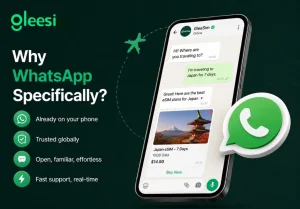
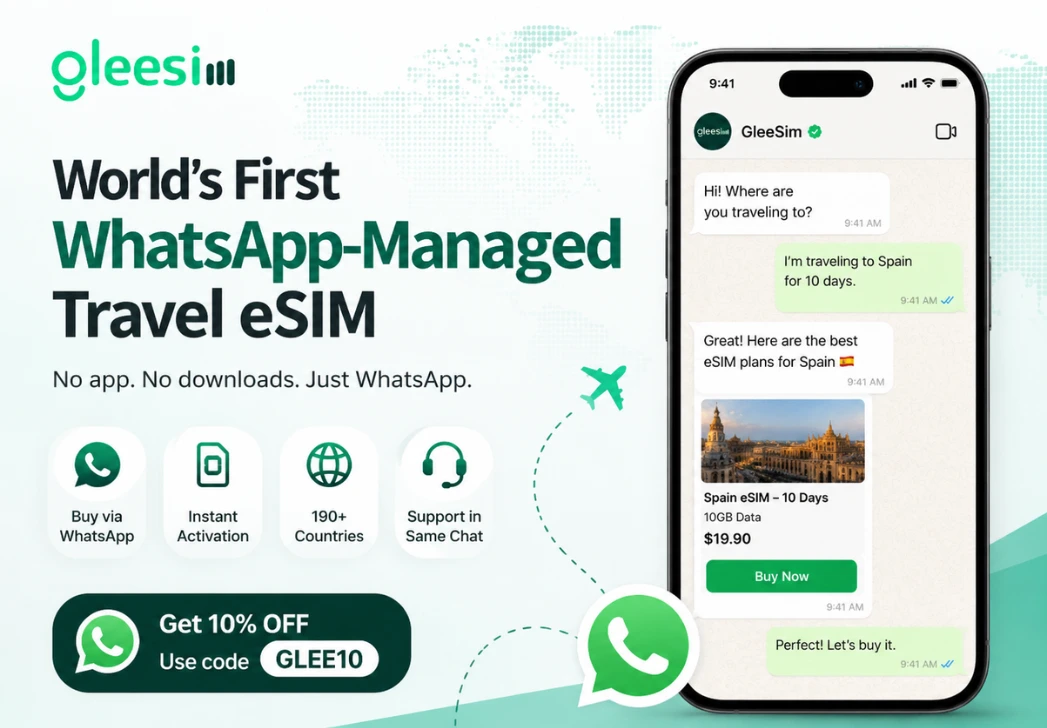
WhatsApp is already installed on the overwhelming majority of international travelers’ phones, already open multiple times a day, and already trusted with far more sensitive conversations than a data plan purchase, family logistics, work coordination, and personal messages that people would never dream of routing through an unfamiliar third-party app. Building the entire GleeSim experience, browsing, buying, activating, topping up, and getting support, inside that existing app meant removing every point of friction that a dedicated app would have introduced by default, without asking travelers to extend trust to a brand-new platform they had never used before.
App-free activation: a purchase and setup flow completed entirely inside an existing messaging app, removing the need to download, register for, or log into a separate provider app before you can buy a plan.
We did not build a login screen. We did not build a password reset flow. We did not build a usage dashboard buried three menus deep that most users would check once and forget existed. Every one of those is standard in a typical eSIM app, and every one of them is friction a WhatsApp-native flow simply does not need, because the conversation itself is the interface, the receipt, the support channel, and the record of every plan ever purchased, all in one place a customer never has to go hunting for.
Removing complexity for the customer meant absorbing more of it ourselves. A conversational commerce flow has to handle a much wider range of phrasing and intent than a rigid app menu with fixed buttons, someone might say “I need data for two weeks in Spain” or “add more data, I’m running low” in a dozen different ways, and the system needs to understand all of them naturally rather than forcing a traveler to match a predefined menu structure. That investment sits behind the scenes, invisible to the customer, which is exactly the point.
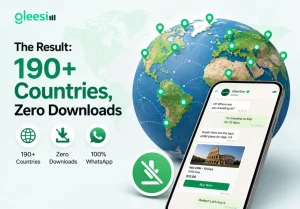
GleeSim now covers 190+ countries through the exact same chat-based flow, proving that removing the app was not a tradeoff against scale or coverage, it was a removal of unnecessary complexity that never needed to exist in the first place. A traveler messaging about a trip to Kazakhstan gets the same fast, app-free experience as one messaging about a trip to France, regardless of how niche or mainstream the destination is.
| Step | Typical app-based provider | GleeSim |
| Download required | Yes | No |
| Account creation | Yes | No |
| Password to remember | Yes | No |
| Where support lives | Separate ticket system | Same chat thread |
Is GleeSim really the first travel eSIM provider to run entirely through WhatsApp? GleeSim was built from the ground up around a WhatsApp-native purchase and management flow, with no companion app required at any stage of the customer journey, from first message to final top-up.
Does removing the app mean fewer features than app-based competitors? No, plan browsing, purchase, activation, top-ups, and support all happen through the same conversation, covering the same core needs an app-based dashboard would, just without the extra screens in between.
Why do most competitors still require an app if the friction is real? Building around an existing platform like WhatsApp requires a different technical and support architecture than a standalone app, which is likely why most providers have not made the shift, it is a genuinely different product decision, not a simple feature toggle.
Does this approach work for business or group travel too? Yes, individual eSIMs for team members or families can all be coordinated within the same or linked WhatsApp threads, without each person needing to separately download and register on an app.
Is there a plan to eventually add a companion app? GleeSim’s product philosophy is built around removing app dependency, not reintroducing it, so the WhatsApp-first approach remains the core of the product rather than a stepping stone toward one.
What was the hardest part of building a purchase flow entirely through a messaging app? Handling the natural variety of how people phrase requests conversationally, rather than relying on fixed menu buttons, was the main engineering challenge, solved so the customer never has to think about it.
Read more about the philosophy behind the product on the GleeSim homepage or experience the flow yourself at offers.gleesim.com.
Use code GLEE10 when purchasing via WhatsApp
No registration required Purchase as a guest Under 2 minutes Buy & manage directly via WhatsApp
Save 10% with GLEE10