
A Ziyarah to Najaf alone is one journey. A Ziyarah that continues to Kazmain in Baghdad and then north to Samarra is something else entirely. It is three cities, three shrines, three distinct connectivity environments, and hundreds of kilometres of Iraqi highway across different governorates.
Pilgrims who plan this multi-city itinerary often prepare well for the shrine visits and less well for the road between them. The connectivity picture changes city by city. The transport options carry different cost and time trade-offs. Samarra specifically requires a level of logistical awareness that Najaf and Kazmain do not.
This guide gives you the practical picture for each leg of the journey: what mobile coverage is like in each city, how to move between them, how long each road segment actually takes, and what to know about checkpoints and security procedures before you plan your route.
Understanding what you are visiting in each city shapes every logistical decision you make about timing, transport, and accommodation.
Najaf: Home of the shrine of Imam Ali ibn Abi Talib (AS), the first Imam. Najaf is the most visited holy city in Iraq for Shia pilgrims globally and has the most developed pilgrimage infrastructure of the three cities. Najaf International Airport (NJF) makes it the natural starting point for most international pilgrims.
Kazmain (Kadhimain/Kadhimayn): A district in northwestern Baghdad containing the shrine complex of Imam Musa al-Kadhim (AS), the seventh Imam, and Imam Muhammad al-Jawad (AS), the ninth Imam. Kazmain is not a separate city but a historic neighbourhood within Baghdad, approximately 12 km northwest of central Baghdad. Reaching it means navigating Baghdad city.
Samarra: A city approximately 125 km north of Baghdad in Saladin Governorate, home to the shrine of Imam Ali al-Hadi (AS), the tenth Imam, and Imam Hassan al-Askari (AS), the eleventh Imam, collectively known as the Askari shrines. The golden dome, destroyed by bombings in 2006 and 2007, has been substantially rebuilt and the shrine complex is fully accessible to pilgrims.
Najaf has the most developed mobile infrastructure of the three destinations for pilgrim-heavy traffic. Asiacell and Zain Iraq both maintain strong 4G coverage throughout the shrine district, accommodation areas, and the roads connecting Najaf to Karbala and Baghdad.
WhatsApp calls, group coordination, navigation, and media sharing all work at functional speeds under normal conditions. During Arbaeen and major Ziyarah dates, congestion builds near the shrine as detailed in the dedicated Arbaeen connectivity guide in this series. For a regular Ziyarah visit outside of peak events, Najaf connectivity is broadly reliable.
Best network in Najaf: Asiacell for strongest indoor coverage at the Imam Ali (AS) shrine. Zain Iraq is a solid alternative for voice calls.
Baghdad has the strongest mobile network infrastructure in Iraq by a significant margin. Kazmain, as part of the wider Baghdad metropolitan area, benefits from multiple cell towers with overlapping coverage throughout the district.
4G speeds in Kazmain during a regular visit are the highest you will experience on this entire pilgrimage route. WhatsApp video calls are reliable. Navigation is smooth. Media uploads to family group chats are fast. If you are saving any heavy data tasks (backing up photos, downloading offline maps for Samarra, sending long video messages), Kazmain is the logical place to do them before the Samarra leg.
Coverage note: Kazmain’s side streets near the shrine can be narrow and dense. Your GPS may lose line-of-sight accuracy in the tightest alleyways, though data coverage remains strong. Download your Kazmain shrine map offline as a belt-and-braces measure regardless of how good the local coverage is.
Samarra city has 4G coverage on both Asiacell and Zain networks in the central city area, including the shrine district. This is better than many pilgrims expect based on Samarra’s reputation as a more remote destination.
The connectivity concern for Samarra is not the city itself but the highway north from Baghdad. The Baghdad-to-Samarra road runs through Saladin Governorate and has sections with reduced or intermittent 4G coverage, particularly in rural stretches between towns. Data often drops to 3G or edge coverage in the open stretches of the highway. This is relevant for navigation and for pilgrims relying on live WhatsApp location sharing during the journey.
Practical action: Download offline maps for the entire Baghdad-to-Samarra route before you leave Kazmain. Your GPS tracks your position accurately even in dead zones, but only if you have the offline map already stored on your device.
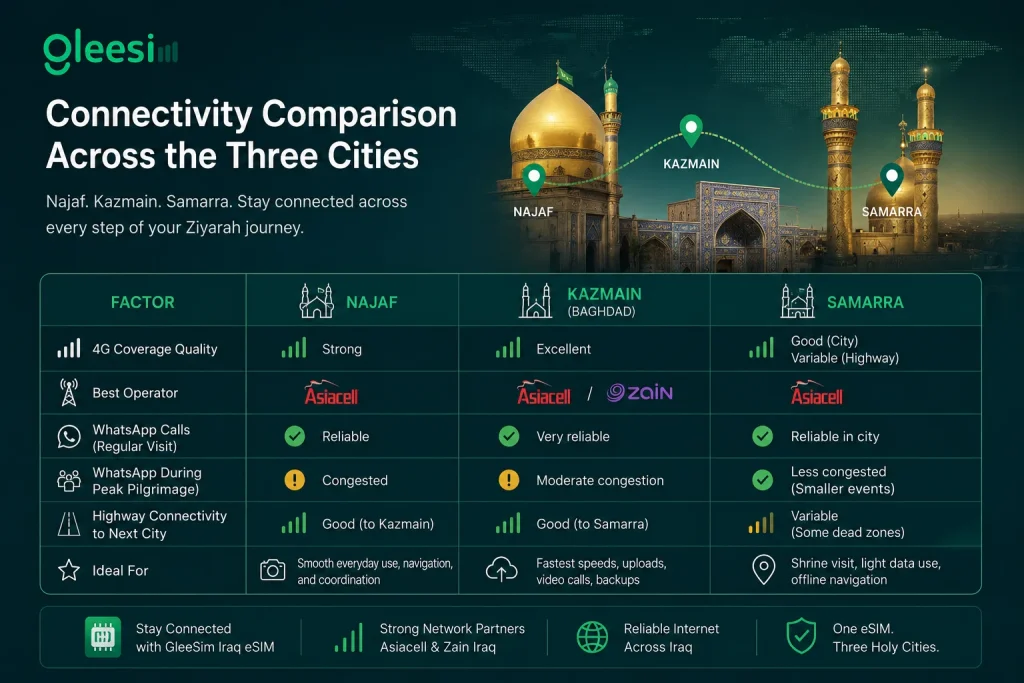
| Factor | Najaf | Kazmain (Baghdad) | Samarra |
| 4G coverage quality | Strong | Excellent | Good (city); Variable (highway) |
| Best operator | Asiacell | Asiacell or Zain | Asiacell |
| WhatsApp calls (regular visit) | Reliable | Very reliable | Reliable in city |
| WhatsApp during peak pilgrimage | Congested | Moderate congestion | Less congested (smaller events) |
| Highway dead zones | Minimal | N/A (city) | Yes, Baghdad-Samarra route |
| Recommended offline map prep | Yes | Yes | Mandatory |
A GleeSim Iraq eSIM activated before your flight provides data coverage across all three cities and the roads between them through roaming on Iraqi network infrastructure. Managing your bundle through WhatsApp means you can top up or check your remaining data from any point on the route, including during the journey between cities, without visiting a dealer or dialling a USSD code.
This is the most straightforward leg of the journey. The Najaf-to-Baghdad highway is a well-maintained dual carriageway with consistent traffic and multiple rest points.
| Transport Option | Journey Time | Cost (approx.) | Group Suitability |
| Shared taxi (service) | 2.5 to 3.5 hours | USD 8 to 15 per person | Solo or pairs |
| Private hire car | 2 to 2.5 hours | USD 50 to 80 | Small groups (3 to 4) |
| Organised pilgrimage bus | 3 to 4 hours (including stops) | USD 5 to 10 per person | Large groups |
| Domestic flight | No direct Najaf-Baghdad flight available | N/A | N/A |
Shared service taxis depart from the main transport hub near Kufa and drop passengers at agreed Baghdad destinations. For pilgrims heading specifically to Kazmain, confirm that your driver will go to the Kazmain area rather than central Baghdad, as these are distinctly different districts.
A private hire car is the most efficient option for groups of three to five pilgrims, particularly those with elderly members or heavy luggage. Negotiate the rate before departure and confirm that the driver will wait at your Kazmain destination while you perform Ziyarah.
This leg requires the most careful planning. The route passes through northern Baghdad and then north along the main highway through Saladin Governorate.
| Transport Option | Journey Time | Cost (approx.) | Notes |
| Private hire car | 2 to 2.5 hours | USD 60 to 100 | Most recommended for pilgrims |
| Organised pilgrimage bus | 3 to 4 hours | USD 10 to 20 per person | Check operator’s Samarra license |
| Shared taxi | 2.5 to 3.5 hours | USD 10 to 18 per person | Multiple vehicle changes may be needed |
For the Samarra leg specifically, a private hire car with a driver who knows the route and checkpoint procedures is strongly recommended over shared transport options. Your driver’s familiarity with the checkpoints and their current documentation requirements reduces friction at security points significantly.
Some pilgrimage tours run a direct Najaf-to-Samarra route, bypassing a separate Kazmain stop or combining Kazmain as a midpoint on the way north. This is logistically efficient if your itinerary visits all three cities sequentially.
| Option | Stops | Total Journey Time | Notes |
| Direct Najaf to Samarra (no Kazmain) | None | 4 to 5 hours | Efficient, misses Kazmain |
| Najaf, Kazmain stop, then Samarra | Kazmain Ziyarah | One to two days | Full three-shrine itinerary |
| Tour operator package (all three) | Managed itinerary | Three to five days | Recommended for first-timers |
If your itinerary includes all three shrines, the practical recommendation is to spend at least one night in Kazmain before continuing to Samarra rather than attempting all three in a single day. The journey times are manageable individually, but combining three shrine visits, their associated prayer and Ziyarah periods, and two long road journeys into one day is physically exhausting and reduces the quality of each visit.
This is one of the most frequently asked questions about the Samarra leg and it deserves a direct, honest answer.
Foreign pilgrims do not require a separate special permit to visit Samarra beyond their standard Iraqi entry visa. However, the route to Samarra passes through security checkpoints where you will be required to present your passport and answer basic questions about your destination and purpose of travel.
What to expect at checkpoints:
– Show your passport when requested
– State that you are a pilgrim visiting the Askari shrines (Maqam al-Askariain)
– Your driver will typically communicate with checkpoint personnel in Arabic
– Checkpoint processing for a private car with a trusted driver usually takes five to fifteen minutes
– Groups travelling on organised pilgrimage buses with a licensed tour operator often pass through checkpoints faster because the bus and operator are pre-registered
Current security situation: The security situation in Samarra and the Baghdad-to-Samarra corridor has improved significantly since the peak instability of the 2014 to 2017 period. Pilgrim traffic to Samarra is a regular, organised flow and the Iraqi security apparatus is experienced in managing it. Check your home country’s current travel advisory for Iraq before finalising your Samarra itinerary, as official advisories are updated more frequently than any travel guide.
Practical tip: Carry printed copies of your visa, passport photo page, and hotel or accommodation address in Iraq at all times when travelling between cities. Digital documents on your phone may not be acceptable at all checkpoints.
This is a route planning question with a clear practical answer.
The most commonly used route from Najaf to Samarra goes through Baghdad. The highway infrastructure on this route is more reliable, better maintained, and more consistently policed than alternative rural roads. Your driver will almost certainly recommend this route.
| Route | Distance | Road Quality | Checkpoint Frequency | Recommended |
| Via Baghdad (main highway) | Approximately 280 km | Good | Regular, manageable | Yes |
| Via alternative rural roads | Varies | Variable | Less predictable | Only with experienced local driver |
For first-time pilgrims and for groups without a locally experienced driver, the Baghdad highway route is the standard choice. It is longer in kilometres but more predictable in travel time and checkpoint experience.
Timing your road travel makes a meaningful difference to journey time and checkpoint experience.
Morning departure (6am to 9am): Early morning departures from Najaf or Baghdad capture the lightest traffic conditions of the day. Checkpoints are typically less congested in the morning and processing times are shorter. This is the recommended window for the Kazmain-to-Samarra leg in particular.
Midday travel: Baghdad city traffic is at its worst in the late morning to early afternoon. If you are transiting through Baghdad between Najaf and Kazmain, or from Kazmain north to Samarra, the midday period adds significant time to the Baghdad sections of the journey without meaningful benefits.
Afternoon and evening: Arriving at a new city in the evening is generally manageable for Najaf and Baghdad, where accommodation and late-night services are well established for pilgrims. Arriving in Samarra late in the evening requires more careful planning as accommodation options are more limited and less easily navigated in the dark.
The practical rule for this itinerary: Depart each leg of the journey in the morning. Arrive at your next city with daylight remaining. Perform Ziyarah, rest, and depart again the following morning. This rhythm gives you the best road conditions, the most manageable checkpoint experience, and adequate time at each shrine.
| Factor | Private Hire Car | Organised Pilgrimage Bus |
| Flexibility | High (your schedule) | Low (fixed departure times) |
| Checkpoint experience | Faster (less people to process) | Slower but operator-facilitated |
| Cost (solo) | Higher per person | Lower per person |
| Cost (group of 4 to 6) | Competitive | Lower if seats available |
| Driver knowledge of route | Varies, confirm before hire | Generally experienced operators |
| Breakdown risk management | Limited (you arrange) | Tour operator arranges |
| Recommended for | Small groups, elderly pilgrims | Budget-conscious, large groups |
For a three-city itinerary covering Najaf, Kazmain, and Samarra, an organised pilgrimage tour with a reputable operator is the most practical option for first-time pilgrims. The operator handles route logistics, checkpoint familiarity, accommodation coordination, and driver arrangements across all three cities. The loss of flexibility is a worthwhile trade for the reduction in logistical burden across a multi-city itinerary.
For experienced Iraq pilgrims or small groups with a locally connected driver, private hire gives you the schedule control to stay longer at shrines that move you and move faster through sections that do not.
For the Najaf-to-Kazmain leg specifically, shared service taxis are a practical and affordable option used by thousands of pilgrims weekly. For the Kazmain-to-Samarra leg, the calculation shifts.
The Samarra route is not a standard taxi route in the way Najaf-to-Karbala or Najaf-to-Baghdad is. Fewer drivers operate this route as a shared service and those who do may change vehicles at intermediate points, which adds complexity and time. A hired private car for the Samarra leg gives you a single driver, a known vehicle, and agreed accountability for the full journey.
Budget estimate for a complete three-city itinerary (Najaf, Kazmain, Samarra, return to Baghdad or Najaf):
| Transport Approach | Estimated Cost per Person | Estimated Cost for Group of 4 |
| All shared taxis | USD 30 to 55 | USD 120 to 220 |
| Private hire (all legs) | USD 80 to 140 | USD 200 to 350 (total, not per person) |
| Tour operator package | USD 100 to 200 | Varies by operator, often better value |
A single Iraq SIM or eSIM handles connectivity across all three cities. You do not need separate SIMs for different governorates. Iraqi mobile networks are national, not regional.
Pre-departure connectivity setup: Activate your GleeSim Iraq eSIM before your flight. Confirm it is working in Najaf before starting the inter-city journey. Asiacell and Zain SIMs purchased at Najaf airport work equally across Najaf, Baghdad, Kazmain, and Samarra.
Offline maps for the full itinerary: Download these map regions before leaving Najaf, where you have the most time and the most reliable Wi-Fi access:
– Google Maps offline for Najaf city
– Google Maps offline for Baghdad (includes Kazmain district)
– Google Maps offline for Samarra city
– Google Maps route download for the Najaf to Baghdad highway
– Google Maps route download for the Baghdad to Samarra highway
Maps.me with the Iraq country file covers all of the above in a single download. At approximately 150 to 200 MB, it is the most efficient single download for a multi-city Iraq itinerary.
During the highway between cities: Your phone’s GPS shows your current position on an offline map even when mobile data is unavailable. In the dead zones on the Baghdad-to-Samarra highway, you can still see where you are, how far you have travelled, and approximately how far remains to the destination. This is a comfort and a safety measure, not a navigation luxury.
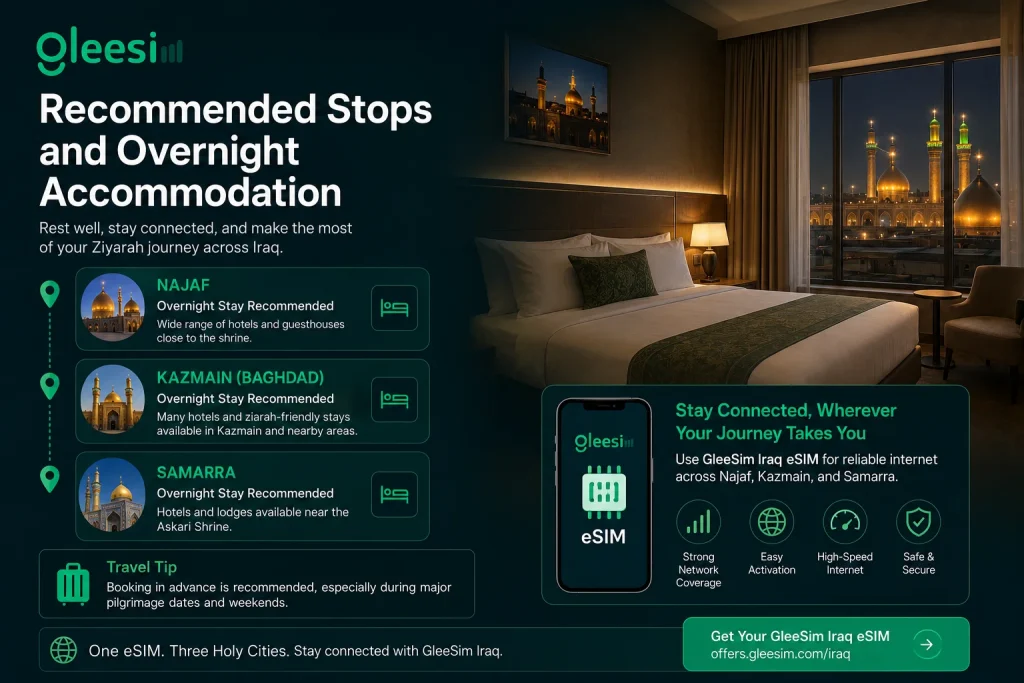
The pilgrimage infrastructure in Najaf is the most developed of the three cities. Hotels of all price ranges cluster within walking distance of the Imam Ali (AS) shrine. Book in advance for any major Islamic date. Standard Ziyarah visits outside peak seasons have reasonable availability.
Options range from budget guesthouses in the Kazmain district itself to mid-range and higher hotels in the wider Baghdad area. Staying within the Kazmain district minimises your reliance on transport for the shrine visit itself. Confirm with your accommodation that they are familiar with pilgrim guests and can provide basic guidance on shrine visiting hours.
Samarra has fewer accommodation options than Najaf or Baghdad. Pilgrimage guesthouses and basic hotels serve the regular pilgrim flow, but the range is narrower and the infrastructure less established. Confirm your accommodation before departure rather than arriving and searching. Tour operators with Samarra experience are the most reliable source of vetted accommodation recommendations.
A practical three-city overnight schedule:
| Day | Location | Activity |
| Day 1 | Najaf | Arrive, Ziyarah Imam Ali shrine, overnight |
| Day 2 | Najaf / depart for Kazmain | Morning Ziyarah, afternoon departure |
| Day 2 evening | Kazmain (Baghdad) | Arrive, Ziyarah Imam Musa al-Kadhim and Imam Jawad shrines |
| Day 3 | Kazmain / depart for Samarra | Morning Ziyarah, depart early for Samarra |
| Day 3 afternoon | Samarra | Arrive, Ziyarah Askari shrines, overnight |
| Day 4 | Samarra / return | Morning Ziyarah, depart to Baghdad for flight or onward journey |
Each shrine complex has its own visiting protocols and it is worth understanding them before you arrive.
Imam Ali (AS) shrine, Najaf: The main shrine is open to visitors of all backgrounds. Dress modestly: covered arms and legs for men, full abaya or equivalent for women. Shoes are removed at the entrance. Photography in the outer courtyard is generally permitted; flash photography inside the shrine is discouraged and specific areas may be photography-restricted. The shrine operates continuous visiting hours with brief prayer-time closures.
Imam Musa al-Kadhim (AS) and Imam Jawad (AS) shrines, Kazmain: The Kazmain complex houses both shrines within a single courtyard. Similar dress requirements to Najaf apply. The shrine complex is in a dense urban district of Baghdad and the surrounding streets are busy at all hours. Keep group members together during the approach and confirm a meeting point near the main gate before entering.
Askari shrines, Samarra: The Askari complex is the destination of the journey and requires the same respectful dress and conduct as the other shrines. The golden dome reconstruction is visible as you approach and is a moving sight for pilgrims arriving after years of wanting to visit. The shrines have visiting hours that your tour operator or local guide should confirm in advance, as temporary closures can occur around security reviews or maintenance.
What are the safest transport options for pilgrims traveling from Najaf to Kadhimain?
A private hire car with a driver experienced in the Najaf-to-Baghdad route is the most reliable option for groups and elderly pilgrims. Shared service taxis are affordable and widely used by solo pilgrims and pairs. Organised pilgrimage bus services run by licensed operators are the most hands-off option. All three are used regularly by thousands of pilgrims.
How long does it take to travel by road from Najaf to Samarra and are there direct buses?
The full Najaf-to-Samarra journey via Baghdad takes approximately four to five hours by road under normal conditions. Direct buses running the full Najaf-to-Samarra route are not a standard scheduled service. Most pilgrims either hire a private car for the full journey or use a tour operator package that covers the complete itinerary. Breaking the journey with an overnight stop in Kazmain is the recommended approach.
Do I need special permits or security clearance to visit Samarra from Najaf or Baghdad?
No special permit beyond your standard Iraqi entry visa is required to visit Samarra. You will pass through security checkpoints on the route and will be asked to show your passport and state your pilgrimage destination. Travelling with an experienced driver or organised tour operator facilitates smoother checkpoint processing.
Are there recommended stops or overnight places when going Najaf to Kazmain to Samarra?
The standard itinerary includes an overnight stay in Najaf, an overnight in Kazmain (Baghdad), and an overnight in Samarra before returning. Attempting all three shrines in a single day is physically demanding and reduces the quality of each Ziyarah. Hillah (near Babylon) is sometimes used as a mid-route rest stop between Najaf and Baghdad but does not warrant a dedicated overnight on a shrine-focused pilgrimage.
What time of day is best to travel between these cities to avoid checkpoints and traffic?
Morning departures between 6am and 9am are consistently the best window for inter-city travel in Iraq. Morning checkpoint processing times are shorter, Baghdad city traffic is lighter before the midday peak, and you arrive at each destination with daylight remaining for orientation and accommodation check-in.
Carrying this information offline across the full itinerary is essential because you will be in different governorates at different points.
| Service | Contact |
| Iraqi Police (national) | 104 |
| Ambulance | 122 |
| Civil Defence | 115 |
| Najaf Health Directorate | +964 33 2312345 |
| Karbala Health Directorate | +964 32 3331111 |
| Baghdad Emergency Services | 130 |
| Pakistani Embassy Baghdad | +964 7901 289 001 |
| UK Embassy Baghdad | +964 7901 926 280 |
| FCDO 24-hour helpline | +44 1908 516 666 |
Health precautions for a multi-city Iraq itinerary: Travel insurance that covers Iraq specifically is a prerequisite, not an optional extra. Confirm that your policy covers medical treatment in Iraq and medical evacuation if required. Standard travel insurance from many European and South Asian providers excludes Iraq or applies significant restrictions. Read your policy terms before travel.
Vaccinations recommended for Iraq travel include Hepatitis A, Hepatitis B, Typhoid, and standard routine vaccinations. Consult your GP or travel health clinic at least six weeks before departure to allow time for any multi-dose vaccination schedules.
This decision has a clearer answer for the three-city Najaf-Kazmain-Samarra route than it does for a single-city Najaf or Karbala visit.
For first-time pilgrims to Iraq: A guided tour is the strong recommendation. The Samarra leg in particular involves checkpoint navigation, route familiarity, and accommodation pre-arrangement that a good operator handles invisibly and that an independent first-time traveller must research carefully.
For experienced Iraq pilgrims: Independent travel is perfectly feasible with a locally connected driver, pre-booked accommodation in all three cities, and the connectivity setup to manage logistics on the move.
What a good tour operator provides for this itinerary:
– Checkpoint-experienced drivers for the Samarra route
– Pre-arranged accommodation in Kazmain and Samarra
– Emergency coordination if there are delays or disruptions
– Local contacts at each shrine for accessibility and timing guidance
What independent travel requires:
– A vetted private driver familiar with all three routes and checkpoints
– Pre-confirmed accommodation (not bookable on arrival in Samarra)
– Offline maps and connectivity across all three cities
– Personal responsibility for all logistics at each stage
One data connection covers the full Najaf-Kazmain-Samarra route. You do not need to change SIMs between cities.
GleeSim offers Iraq eSIM plans that activate before your flight and work across the entire country, managed through a WhatsApp conversation at any point on the route. Between Najaf and Baghdad, at your Kazmain hotel, or sitting in the car on the way to Samarra, your data plan management stays inside WhatsApp without requiring you to find a dealer, dial a USSD code in Arabic, or open an app you downloaded for one specific task.
For a multi-city itinerary where your logistics are more complex than a single-shrine visit, having your data connection sorted before you land and manageable without extra apps or counter visits removes one variable from a journey that already has many moving parts.
Browse Iraq eSIM data plans and activate yours over WhatsApp before your Ziyarah at offers.gleesim.com/iraq.
This guide reflects general conditions based on publicly available information at the time of writing. Security situations, checkpoint requirements, and transport options in Iraq may change. Always check your home country’s current official travel advisory for Iraq before departure. Visa requirements should be verified with the Iraqi Embassy in your country. Emergency contact numbers should be confirmed before travel.